
PCOS and GLP-1 Statistics 2026 | Prescribing Trends & Clinical Data
Why Prescribing for This Condition Jumped Seven-Fold in Four Years
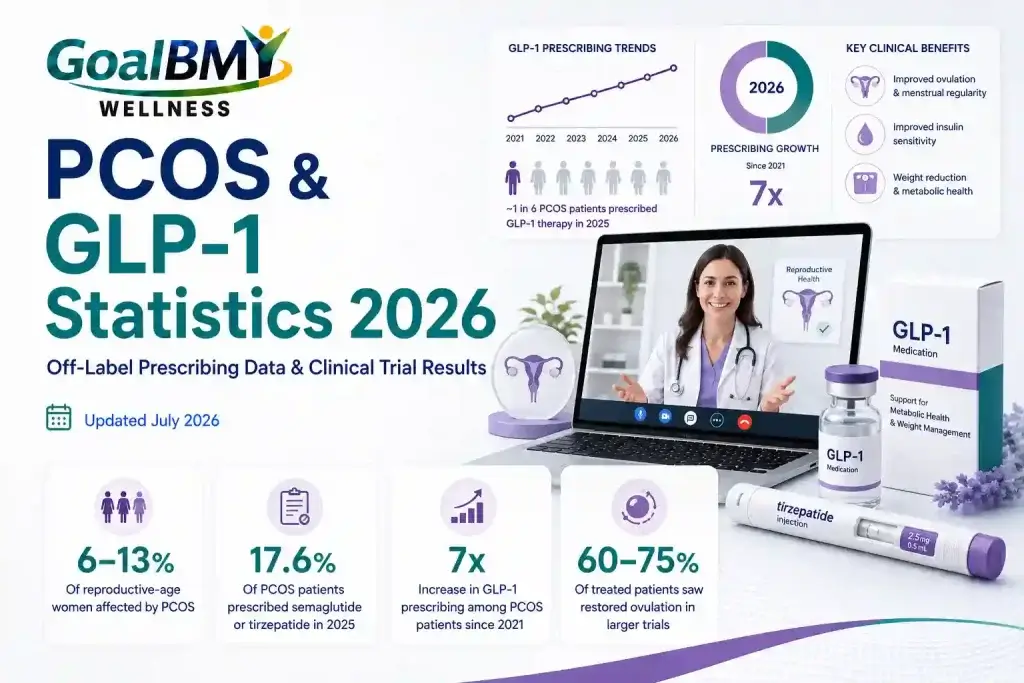
Polycystic ovary syndrome affects up to 13% of reproductive-age women, and GLP-1 prescribing among this population has risen seven-fold since 2021. Here’s what the clinical trial data actually shows about weight loss, menstrual regularity, and where the evidence is strongest.
Polycystic ovary syndrome is the most common endocrine disorder in reproductive-age women, and it’s increasingly understood as a metabolic condition rooted in insulin resistance — not simply a reproductive one. That reframing has driven a dramatic rise in GLP-1 prescribing for PCOS patients, almost entirely off-label. This page compiles the current prescribing data and what the clinical trials actually show.
How Common Is PCOS, and Why Does It Matter Here?
PCOS prevalence estimates vary by diagnostic criteria used, but every major estimate places it as the most common hormonal disorder in women of reproductive age.
Prescribing Has Risen Seven-Fold Since 2021
Real-world prescribing data tracks a clear, accelerating trend as evidence has accumulated.
From 2.4% to 17.6% in Four Years
A Truveta analysis of real-world data from January 2021 to September 2025 found that semaglutide or tirzepatide prescribing among women with PCOS rose from 2.4% in 2021 to 17.6% in 2025 — more than a seven-fold increase. The analysis compared two patient cohorts: those prescribed semaglutide or tirzepatide, and those with a recorded PCOS diagnosis. (Source: Truveta, May 2026)
On-Label vs. Off-Label: A Critical Distinction
No GLP-1 medication is FDA-approved specifically for PCOS. Whether a prescription is on-label or off-label depends entirely on the patient’s individual weight criteria.
| Medication | FDA-Approved Indication | Status for PCOS |
|---|---|---|
| Semaglutide (Wegovy®) | Chronic weight management, BMI ≥30, or ≥27 with a comorbidity | On-label if weight criteria met |
| Tirzepatide (Zepbound®) | Chronic weight management, same criteria as Wegovy® | On-label if weight criteria met |
| Tirzepatide (Mounjaro®) | Type 2 diabetes management | On-label only if diabetic |
| Any GLP-1 for PCOS symptoms specifically | No PCOS-specific approval exists | Off-label |
Off-Label Prescribing Is Legal and Common in Medicine
For a woman with PCOS who also has obesity or overweight with a metabolic comorbidity, Wegovy® or Zepbound® can be prescribed on-label for the weight management indication — the PCOS context doesn’t change the prescribing legality. For lean women with PCOS who don’t meet weight eligibility criteria, prescribing a GLP-1 specifically for PCOS symptoms is fully off-label. Off-label prescribing is legal, widespread across medicine, and clinically appropriate when supported by evidence — which reproductive endocrinologists increasingly consider to be the case here. (Source: Telehealth Ally, April 2026)
What the Clinical Trials Actually Show
The evidence base is strongest for semaglutide, with tirzepatide data still accumulating.
Semaglutide Is the Better-Evidenced Agent
Several randomized trials conducted between 2021 and 2025 showed semaglutide 1.0–2.4mg weekly produces roughly 10–15% weight loss in PCOS patients over 6–12 months, with parallel improvements in menstrual cycle frequency, testosterone, sex hormone-binding globulin (SHBG), and HOMA-IR (a marker of insulin resistance). As of April 2026, no PCOS-dedicated randomized controlled trial has published for tirzepatide — the evidence base for tirzepatide in PCOS remains real-world and observational rather than trial-based. (Source: WeightSherpa, March 2026)
ObesityWeek 2025 Real-World Tirzepatide Data
Real-world data presented at ObesityWeek 2025 showed over 90% of PCOS patients lost at least 10% of body weight within 10 months on tirzepatide, with a mean weight loss of 18.81% — comparable to tirzepatide’s general SURMOUNT-1 trial results (22.5% at the highest dose). This is observational, real-world clinic data rather than a randomized controlled trial. (Source: iPharma Pharmacy, 2026)
Why GLP-1s Address the Root Cause, Not Just Symptoms
The clinical rationale for using GLP-1 medications in PCOS rests on treating the underlying metabolic driver rather than individual symptoms.
Tirzepatide’s Dual Mechanism May Offer a Compliance Advantage
Because tirzepatide activates both GLP-1 and GIP receptors, researchers have hypothesized its dual mechanism may reduce the intensity of gastrointestinal side effects compared to single-receptor GLP-1 agonists — a meaningful consideration since GI side effects are a leading cause of treatment discontinuation. However, tirzepatide “may not benefit those who are of normal weight,” and its use is specifically considered valuable for PCOS patients who are obese with metabolic syndrome. (Source: Journal of Clinical Medicine, 2023)
Slower Titration May Help PCOS Patients Specifically
Some clinical sources note that women with PCOS “often tolerate medication differently” and may benefit from slower, more personalized dose titration to ease gastrointestinal side effects that otherwise lead many patients to discontinue treatment too early. This underscores the value of individualized, physician-supervised dosing rather than a fixed one-size-fits-all schedule.
Important Considerations for PCOS Patients Specifically
Two considerations apply specifically to reproductive-age women with PCOS that don’t necessarily apply to the general GLP-1 patient population.
The Fertility Paradox Worth Discussing With Your Provider
For patients not actively trying to conceive, restored ovulation can be an unexpected and clinically significant side effect of treatment — meaning contraception planning should be part of the conversation when starting GLP-1 therapy for PCOS, not an afterthought.
GLP-1 Support for PCOS at GoalBMI Wellness
GoalBMI Wellness provides physician-supervised GLP-1 programs for eligible patients, with individualized dose titration and evaluation for weight-related eligibility criteria — including patients whose PCOS is accompanied by obesity or overweight with a metabolic comorbidity.

Before & After — Physician-Supervised Results at GoalBMI Wellness
Individualized titration and consistent monitoring matter especially for patients managing PCOS alongside weight goals. These results reflect physician-supervised GLP-1 programs at GoalBMI Wellness.

See more patient before & after results →
Results disclaimer: Individual results may vary. Photos represent real patients from physician-supervised GoalBMI Wellness programs shared with patient consent. Results depend on individual health factors, program adherence, and clinical evaluation.
How the Evidence Base Developed
Frequently Asked Questions
Sources & References
- 1Truveta (May 13, 2026). Rising Use of GLP-1 Medications Among Women with PCOS. truveta.com
- 2Expert Review of Endocrinology & Metabolism (2025). Reframing Polycystic Ovary Syndrome as a Complication of Obesity: The Evolving Role of Incretin-Based Therapies. tandfonline.com
- 3WeightSherpa (March 28, 2026). GLP-1s for PCOS: What the Evidence Actually Shows in 2026. weightsherpa.com
- 4Anala A.D. et al. (2023). The Potential Utility of Tirzepatide for the Management of Polycystic Ovary Syndrome. Journal of Clinical Medicine 12(14), 4575. pmc.ncbi.nlm.nih.gov
- 5iPharma Pharmacy (2026). Semaglutide & Tirzepatide for PCOS: Treating the Root Cause. ipharmapharmacy.com
- 6PubMed (March 4, 2026). GLP-1 Receptor Agonist Treatment in Women with Polycystic Ovary Syndrome — A Systematic Review and Meta-Analysis. pubmed.ncbi.nlm.nih.gov
- 7Telehealth Ally (April 28, 2026). PCOS and GLP-1 Medications: A Complete Evidence Review. telehealthally.com
- 8Jastreboff A.M. et al. (2022). Tirzepatide Once Weekly for the Treatment of Obesity (SURMOUNT-1). NEJM 387(3), 205–216. doi.org/10.1056/NEJMoa2206038
- 9Wilding J.P.H. et al. (2021). Once-Weekly Semaglutide in Adults with Overweight or Obesity (STEP-1). NEJM 384(11), 989–1002. doi.org/10.1056/NEJMoa2032183
Medically Reviewed by Karla K. Mioduchoski, FNP-BC
Karla K. Mioduchoski, FNP-BC is a board-certified Family Nurse Practitioner providing physician-supervised medical weight loss, GLP-1 support, and telehealth wellness care through GoalBMI Wellness. All clinical trial and prescribing data in this article was reviewed for accuracy in July 2026.






-
Monday – Friday:: 9:00 AM – 8:00 PMSaturday:: 9:00 AM – 4:00 PMSunday:: 12:00 PM – 8:00 PM