
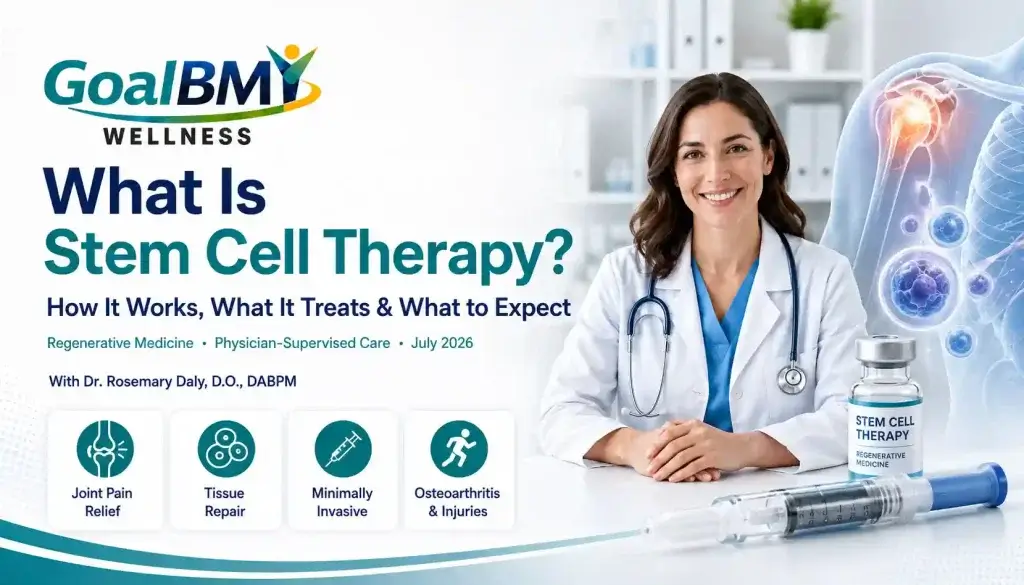
What Is Stem Cell Therapy? How It Works, What It Treats & What to Expect
Let’s Start From the Beginning — What Is Regenerative Medicine?
You may have heard the term regenerative medicine without being entirely sure what it means. Put simply, regenerative medicine takes advantage of your body’s own ability to heal itself. Rather than masking symptoms with medication or replacing damaged tissue through surgery, regenerative therapies work with the body’s natural repair processes to restore function and reduce pain from within.
One of the most well-studied forms of regenerative medicine is stem cell therapy. It has been evaluated in both laboratory settings and clinical practice for several decades, with a growing body of evidence supporting its use for a range of musculoskeletal and pain-related conditions.
So What Is Stem Cell Therapy, Exactly?
Stem cell therapy is an injection-based treatment designed to help heal damaged tissue and reduce pain. It works by introducing stem cells — the body’s own “blank slate” repair cells — into an area of injury or degeneration, where they can support the natural healing process.
Common applications include treatment of osteoarthritis, ligament and tendon injuries, cartilage damage, and joint pain. Stem cell therapy is often considered when other treatments — medications, physical therapy, corticosteroid injections — have not provided adequate relief, or when a patient wants to avoid or delay surgical intervention.
What Exactly Is a Stem Cell?
Stem cells are unique because they are the only cells in the body capable of changing into other types of specialized cells. They act as raw material — capable of becoming skin cells, bone cells, cartilage cells, or many other cell types depending on the signals they receive in their environment.
There are two main categories:
- Embryonic stem cells are pluripotent — they can develop into virtually any cell type in the body. However, their use raises ethical questions and they are not used in clinical practice for pain and regenerative treatments.
- Adult stem cells are multipotent — they can differentiate into a more limited range of specific cell types. They are found throughout the body, with high concentrations in the bone marrow. Using a patient’s own adult stem cells — called autologous therapy — is the approach most commonly used in clinical regenerative medicine.
Using your own stem cells has clear advantages: no risk of rejection, no immune response, and no ethical concerns. For musculoskeletal applications, autologous adult stem cells have shown meaningful clinical results in appropriately selected patients.
How Does the Procedure Work?
The procedure itself is straightforward, minimally invasive, and typically completed in a single office visit. Here is what the process generally involves:
- Collection: Stem cells are harvested from the patient — typically from the pelvic bone or, in some protocols, from adipose (fat) tissue. The collection is done under local anesthesia and takes approximately 30 minutes. Most patients find it far more comfortable than they expect.
- Concentration: The collected material is processed in a centrifuge, which concentrates the stem cells — typically by a factor of seven to ten times — along with other regenerative components including growth factors and platelets.
- Injection: The concentrated preparation is injected precisely into the site of injury or degeneration. Injections are performed with ultrasound or imaging guidance to ensure accurate placement.
- Recovery: Patients are typically able to leave the office immediately after the procedure. Mild soreness at the injection site is common in the first few days. Most patients return to light activity within a day or two.
What Conditions Can Stem Cell Therapy Help With?
The regenerative properties of stem cells have shown clinical value across a range of musculoskeletal conditions. Common applications include:
Osteoarthritis
Joint degeneration affecting the knee, hip, shoulder, and spine. Stem cell therapy may help slow progression and reduce pain in moderate cases.
Ligament & Tendon Injuries
Partial and complete tears of ligaments and tendons that have not healed adequately with conservative care.
Rotator Cuff Tears
Shoulder injuries involving rotator cuff damage. Stem cell injections may support tissue repair and delay or prevent surgical intervention.
Chronic Spine Pain
Disc degeneration, facet joint arthritis, and other structural sources of chronic neck and back pain that have not responded adequately to other treatments.
ACL & PCL Injuries
Stem cell therapy may be used alongside ACL or PCL reconstruction to enhance healing, or in select partial-tear cases as an alternative to surgery.
Joint Pain & Inflammation
Persistent joint pain from various causes where inflammation is a primary driver and conventional anti-inflammatory treatments have been insufficient.
Ready to Find Out If Stem Cell Therapy Is Right for You?
Speak directly with our clinical team. Dr. Rosemary Daly, D.O., DABPM evaluates each patient individually — no two treatment plans are the same. Book online or call our clinic today.
Call our clinic: +1-347-407-7611 · Mon–Fri 9AM–8PM · Sat 10AM–2PMHow Does Stem Cell Therapy Fit Into a Broader Wellness Plan?
At GoalBMI Wellness, we view stem cell therapy not as a standalone intervention but as one component of a comprehensive, physician-supervised approach to health and function. Chronic pain, inflammation, and joint degeneration are closely connected to metabolic health — and many patients seeking regenerative care also benefit from addressing weight, hormonal balance, and systemic inflammation as part of their overall plan.
For patients managing obesity-related joint pain, for example, GLP-1 weight loss treatment and regenerative joint care can work together: reducing the mechanical load on joints while simultaneously supporting tissue healing. Our team assesses each patient’s full health picture before recommending any single treatment.
We also offer peptide therapy — including BPC-157, sermorelin, and other regenerative peptides — which can complement stem cell protocols by supporting tissue repair, reducing inflammation, and improving recovery. These options are discussed individually with each patient based on their clinical history and goals.
What to Expect After Treatment
Stem cell therapy is not an instant fix. The regenerative process takes time, and most patients notice a gradual progression of improvement over four to twelve weeks following treatment. Some patients report earlier responses; others see the full benefit closer to three to six months.
To support the best possible outcome, your physician may recommend:
- Avoiding high-impact activities for a short period following injection
- Beginning or continuing physical therapy to support tissue healing and restore function
- Optimizing protein intake to support regenerative processes
- Addressing any underlying metabolic or inflammatory conditions that could slow healing
Follow-up appointments are an important part of the process — they allow your physician to assess your response, address any concerns, and make adjustments to your plan if needed.
Is Stem Cell Therapy Safe?
When performed by a trained, board-certified physician using appropriate protocols, autologous stem cell therapy — using your own cells — has a well-established safety profile. Because the cells come from your own body, the risk of immune reaction or rejection is essentially eliminated.
As with any injection-based procedure, there is a small risk of localized soreness, swelling, or bruising at the collection or injection site. Serious adverse events are uncommon in properly selected patients under experienced physician supervision.
It is worth noting that not all regenerative therapies marketed to patients carry the same evidence base or regulatory standing. The FDA has issued guidance distinguishing autologous cell therapies from unapproved cell products. A conversation with a board-certified specialist — not a wellness spa — is the appropriate starting point for any patient considering this type of treatment.

Schedule a Consultation With Dr. Rosemary Daly
Find out whether stem cell therapy, PRP, peptide therapy, or another regenerative approach may be right for you. All consultations begin with a thorough clinical evaluation by a board-certified physician — not a sales pitch. Available via telehealth across New York, New Jersey, and Pennsylvania.
Prefer to call? +1-347-407-7611 · Mon–Fri 9AM–8PM · Sat 10AM–2PMReferences
- Daly R., et al. (2019). Essentials of Regenerative Medicine. — Co-authored by Dr. Rosemary Daly, D.O., DABPM.
- Jevotovsky D.S., et al. (2018). Osteoarthritis and stem cell therapy in humans: a systematic review. Osteoarthritis and Cartilage, 26(6), 711–729. doi.org
- U.S. Food and Drug Administration. Cellular & Gene Therapy Products — Regulatory information for autologous stem cell therapies. fda.gov
- NIH National Center for Advancing Translational Sciences. Stem Cell Basics. stemcells.nih.gov
- Physio Logic NYC (2018). What is Stem Cell Therapy? physiologicnyc.com