Telehealth Only • 480 Court St, Brooklyn, NY 11231
GLP-1 Insurance Coverage Statistics 2026 | Employer, Medicare & Medicaid Data
GLP-1 Insurance Coverage Statistics 2026: Employer Plans, Medicare & Medicaid Data | GoalBMI Wellness
📊 Statistics Report — Updated July 2026

GLP-1 Insurance Coverage Statistics 2026: Employer Plans, Medicare & Medicaid Data

The most current data on who actually pays for GLP-1 weight loss medications in 2026. Covers employer plan coverage rates, the new Medicare GLP-1 Bridge Program, state-by-state Medicaid coverage, prior authorization denial and appeal rates, and what patients pay out of pocket.

📅 Last Updated: July 2026 ⏱ 12 min read ✔ Physician Reviewed 📚 11 Cited Sources
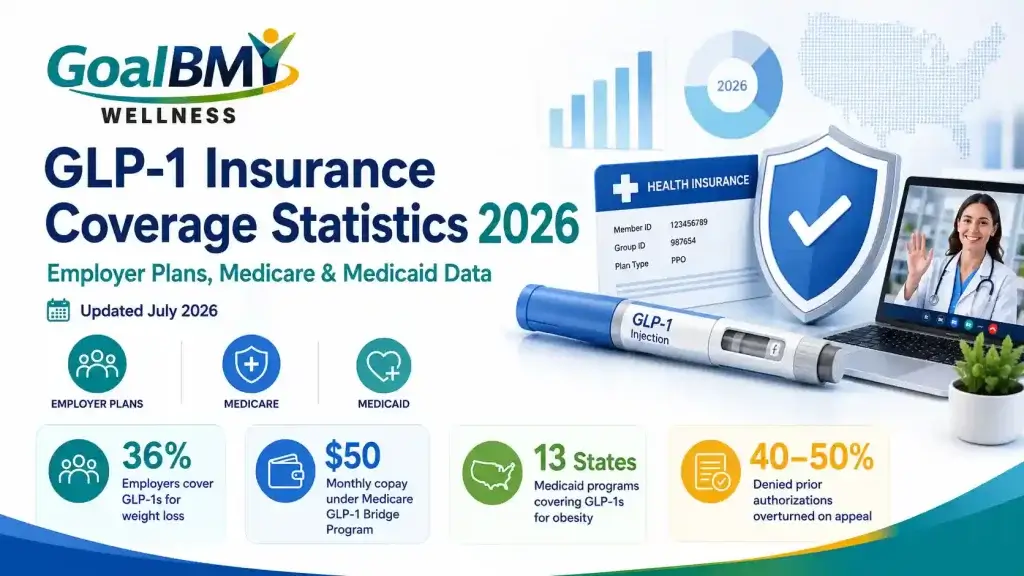
36%
Of employers cover GLP-1s for weight loss
IFEBP Survey, July 2026
$50
Monthly copay under Medicare GLP-1 Bridge Program
CMS / Medicare.gov, July 2026
13
State Medicaid programs covering GLP-1s for obesity
KFF, January 2026
40–50%
Of denied prior authorizations overturned on appeal
AAOPM, April 2026

Insurance coverage is the single biggest factor determining whether a patient can access GLP-1 weight loss treatment. In 2026 the picture is more complicated than ever: employer coverage has plateaued and in some cases reversed, Medicare has launched its first-ever weight loss drug program, and several states have eliminated Medicaid coverage. This page compiles the most current coverage data available — and what it means for patients paying out of pocket.

Section 01

Employer Insurance Coverage of GLP-1 Medications

Most Americans under 65 get health coverage through an employer, making employer plan decisions the largest single determinant of GLP-1 access. The International Foundation of Employee Benefit Plans has tracked this since October 2023, and the 2026 data reveals a clear pattern: coverage for diabetes keeps rising, but coverage for weight loss has stalled.

60%
Of employers cover GLP-1s for diabetes only — up from 49% in 2023
36%
Cover GLP-1s for both diabetes and weight loss — unchanged from 2025
45%
Cover GLP-1s for other FDA-approved conditions like sleep apnea
Employer GLP-1 Coverage Trends 2023–2026 (% of Employers)
Source: International Foundation of Employee Benefit Plans, July 2026. Diabetes-only coverage keeps climbing; weight loss coverage has flatlined since 2025.
📉

Weight Loss Coverage Has Flatlined — and Some Employers Are Cutting It

Employer coverage of GLP-1s for weight loss sat at 36% in both 2025 and 2026, after climbing from 26% in 2023. Meanwhile a Mercer study found that among employers with 500 or more employees, 6% dropped weight loss coverage in 2026, and another 5% are planning or considering dropping it for 2027. Separately, the Business Group on Health reported that 10% of companies currently covering GLP-1s for weight management say they are unlikely to continue in 2027 for cost reasons. (Source: CNBC, June 2026)

💸

GLP-1s Now Account for 11.4% of All Employer Drug Claims

The cost pressure driving these decisions is substantial. In 2023, GLP-1 medications represented 6.9% of annual pharmacy claims for surveyed employers. By 2026 that figure had risen to 11.4% — meaning roughly one in nine dollars of employer drug spending now goes to this single medication class. (Source: IFEBP, July 2026)

Coverage Varies Sharply by Employer Size

Larger employers are significantly more likely to cover weight loss medications. In 2024, 44% of employers with 500 or more employees covered weight loss drugs — but that rose to 64% among employers with 20,000 or more employees. Roughly 45% of large employers now include at least one anti-obesity medication on their formulary, up from about 25% in 2023. (Sources: Mercer; AAOPM, 2026)

Section 02

Medicare GLP-1 Bridge Program — Launched July 1, 2026

For the first time in history, Medicare beneficiaries can access weight loss medications through a federal program. Under longstanding federal law, Medicare Part D plans were prohibited from covering drugs used solely for weight loss. CMS worked around this using its demonstration authority.

$50
Flat monthly copay for eligible beneficiaries
$245
Total monthly cost — CMS covers the balance
Jul 1
2026 — program launch date
2027
Extended through — originally time-limited
How the Bridge Program works: Eligible Medicare beneficiaries pay a flat $50 monthly copay, and CMS covers the remaining balance of the $245 monthly cost. Covered medications are the Wegovy® injection, Wegovy® oral tablets, and the Zepbound® KwikPen — single-dose Zepbound® vials and pens are not covered. A prescriber must submit prior authorization and certify the patient is using the medication as part of a lifestyle program focused on diet and exercise. (Source: Medicare.gov)
⚠️

Two Important Catches in the Bridge Program

First, Bridge Program payments do not count toward True Out-of-Pocket (TrOOP) costs, so they don’t help beneficiaries reach the catastrophic coverage threshold. Second, the program is strictly for weight loss — patients who already have coverage for a qualifying condition such as type 2 diabetes must stay on their standard Part D plan instead. (Source: Healthline, 2026)

🔄

The BALANCE Model Has Been Delayed Indefinitely

CMS originally announced two programs: the GLP-1 Bridge Program and the BALANCE model (Better Approaches to Lifestyle and Nutrition for Comprehensive Health), a five-year CMS Innovation Center model that would have let Part D plans opt in to covering weight loss GLP-1s starting January 2027. The BALANCE model has been delayed indefinitely, and the GLP-1 Bridge Program has been extended through 2027 in its place. (Source: Medicare Rights Center, 2026)

Medicare Eligibility Criteria

RequirementDetail
Medicare drug coverageStandalone Part D plan or Medicare Advantage plan that includes drug coverage
Clinical needMust meet weight and health criteria for weight loss and weight maintenance
Prior authorizationRequired — prescriber must submit and receive approval
Lifestyle programProvider must certify the drug is used alongside a diet and exercise program
Excluded conditionsIf you have type 2 diabetes, sleep apnea, or fatty liver disease, your standard Part D plan may cover GLP-1s instead

Section 03

State Medicaid Coverage — And Why It’s Shrinking

Medicaid coverage of GLP-1s for obesity is decided state by state, and 2026 brought a notable reversal. After years of gradual expansion, several states eliminated coverage entirely amid budget pressure.

13
State Medicaid programs covering GLP-1s for obesity — January 2026
16
States that covered them just three months earlier — October 2025
4
States that eliminated coverage between October 2025 and January 2026
State Medicaid Programs Covering GLP-1s for Obesity Treatment
Source: KFF Medicaid Coverage and Spending on GLP-1s, January 2026. Coverage contracted for the first time in 2026.
Four states dropped coverage in late 2025: California, New Hampshire, Pennsylvania, and South Carolina all eliminated Medicaid coverage of GLP-1s for obesity treatment — reducing the national count from 16 states to 13. KFF attributes this to state budget challenges. Pennsylvania patients on Medicaid who previously had coverage will need to explore alternative options. (Source: KFF, January 2026)
🔒

Even Where Covered, Utilization Controls Limit Access

When state Medicaid programs do cover GLP-1s, coverage is typically subject to prior authorization and other utilization controls that further restrict access in practice. A state appearing on the “covered” list does not mean straightforward access for every eligible beneficiary. (Source: KFF, 2026)


Section 04

Prior Authorization, Denials & Appeal Success Rates

Having coverage on paper is not the same as getting a prescription filled. Prior authorization is the standard gatekeeping mechanism across nearly all payers — and denial rates are meaningful. The good news is that appeals succeed far more often than most patients expect.

The most actionable statistic on this page: Studies show approximately 40–50% of initially denied weight loss medication authorizations are overturned on appeal when supported by detailed clinical documentation. Roughly half of patients who are told “no” and give up would have been approved had they appealed. (Source: AAOPM, April 2026)
Prior Authorization Appeal Outcomes for Weight Loss Medications (%)
Source: AAOPM, 2026. Based on appeals supported by detailed clinical documentation.

Where GLP-1s Sit on Formulary Tiers

UnitedHealthcare, the largest commercial insurer in the United States, generally places GLP-1 receptor agonists on Tier 4 (specialty) or Tier 5 (non-preferred specialty) — the tiers carrying the highest copay or coinsurance amounts. Most major insurers follow a similar structure, meaning even covered patients often face substantial cost sharing.

Employers covering GLP-1s for diabetes60%
Employers covering GLP-1s for other FDA-approved conditions45%
Employers covering GLP-1s for weight loss36%
Denied prior authorizations overturned on appeal40–50%
GLP-1 share of employer pharmacy claims11.4%
Employers with 500+ staff who dropped coverage in 20266%

Section 05

What Self-Pay Actually Costs in 2026

With roughly two-thirds of employers not covering GLP-1s for weight loss, self-pay remains the reality for most patients. Pricing changed substantially in late 2025 and 2026.

Access RouteApproximate Monthly CostNotes
Pre-2025 list price$1,000+Branded GLP-1s before rebates — the historic barrier
TrumpRx negotiated price$245Announced November 2025 for Zepbound®, Mounjaro®, Ozempic®, Wegovy®
Medicare GLP-1 Bridge$50Eligible Medicare beneficiaries only, from July 1, 2026
Manufacturer savings cardAs low as $25Eligible commercially insured patients only
Compounded GLP-1VariesThrough licensed 503A pharmacies when clinically appropriate
💊

The Oral GLP-1 Pills Are Priced Similarly to Injectables

The new oral GLP-1 formulations launched in 2026 were expected by many to lower costs. In practice, the pills are priced essentially the same as the injectables, and clinical trial data shows they are somewhat less effective for weight loss. Some employers may decline to add them to formularies for this reason. (Source: CNBC, June 2026)

The practical takeaway: Insurance verification should be the first step, not an afterthought. Coverage varies enormously by plan, employer size, state, and indication — and roughly half of initial denials are reversible on appeal. Where coverage genuinely isn’t available, self-pay pricing in 2026 is dramatically lower than it was even 18 months ago.

Transparent Pricing

GoalBMI Wellness Pricing — Insurance & Self-Pay Options

GoalBMI Wellness offers free insurance verification for every patient, plus transparent self-pay pricing for those whose plans don’t cover GLP-1 treatment. You know your cost before you commit.

GoalBMI Wellness GLP-1 program pricing — insurance verification and self-pay options for telehealth weight loss patients
🔍

We Handle the Insurance Verification For You

Given that roughly 40–50% of denied prior authorizations are overturned on appeal, having someone who knows the process matters. GoalBMI Wellness checks your benefits before you start, explains exactly what your plan covers, and supports the prior authorization process. If coverage isn’t available, transparent self-pay pricing is offered with no subscription required. Start your free insurance verification →


Real Patient Outcomes

Before & After — Results From Insured and Self-Pay Patients

Clinical outcomes don’t depend on how treatment is paid for. These results are from real GoalBMI Wellness patients across both insurance-covered and self-pay programs — all under the same physician supervision and monitoring protocols.

Before and after semaglutide and tirzepatide weight loss results — GoalBMI Wellness insured and self-pay patients

See more patient before & after results →

Results disclaimer: Individual results may vary. Photos represent real patients from physician-supervised GoalBMI Wellness programs shared with patient consent. Results depend on individual health factors, program adherence, and clinical evaluation.

Clinical context: The SURMOUNT-1 trial showed tirzepatide produced an average 22.5% body weight loss over 72 weeks. The STEP-1 trial showed semaglutide produced an average 15% over 68 weeks. These outcomes are identical whether the medication is paid for by insurance or self-pay — what matters clinically is consistent physician supervision and adherence.

Section 06

GLP-1 Coverage Policy Timeline

October 2023
Coverage Tracking Begins — 26% of Employers Cover Weight Loss
The International Foundation of Employee Benefit Plans begins systematically tracking GLP-1 coverage. At baseline, 49% of employers cover GLP-1s for diabetes and 26% for weight loss. GLP-1s account for 6.9% of annual pharmacy claims.
2024
Coverage Expands as Demand Surges
Weight loss coverage climbs to 34% of employers. Among large employers with 500+ staff, 44% cover weight loss medications — rising to 64% for those with 20,000+ employees. Cost pressure begins mounting as utilization accelerates.
2025
Weight Loss Coverage Plateaus at 36%
Employer coverage for weight loss reaches 36% and stops climbing. Diabetes-only coverage continues rising to 55%. Sixteen state Medicaid programs cover GLP-1s for obesity as of October 2025 — the peak.
November 2025
TrumpRx Pricing Deal Announced — $245/Month Cap
The Trump administration announces agreements with Eli Lilly and Novo Nordisk to lower GLP-1 costs for Medicare, Medicaid, and direct-purchase patients through the TrumpRx platform, capping brand-name prices at approximately $245 per month.
December 2025
BALANCE Model Introduced — Then Four States Cut Medicaid Coverage
CMS introduces the BALANCE model, a five-year Innovation Center program intended to expand obesity drug access in Medicaid. In the same period, California, New Hampshire, Pennsylvania, and South Carolina eliminate Medicaid coverage of GLP-1s for obesity, citing budget pressure.
July 1, 2026
Medicare GLP-1 Bridge Program Launches
For the first time, Medicare beneficiaries can access weight loss medications — Wegovy® injection, Wegovy® oral tablets, and the Zepbound® KwikPen — at a flat $50 monthly copay, with CMS covering the balance of the $245 cost. Prior authorization and lifestyle program participation are required.
July 2026
Employer Coverage Holds at 36% — Cuts Loom for 2027
IFEBP data confirms weight loss coverage unchanged at 36% for a second year. GLP-1s now account for 11.4% of employer pharmacy claims. Six percent of large employers dropped coverage in 2026; 5% are considering it for 2027; 10% of covering companies say they’re unlikely to continue. The BALANCE model is delayed indefinitely and the Bridge Program extended through 2027.

Section 07

Frequently Asked Questions

Among employers, 36% cover GLP-1 medications for weight loss — unchanged from 2025, though up from 26% in 2023. A larger share, 60%, cover GLP-1s for diabetes only, and 45% cover them for other FDA-approved conditions such as sleep apnea and cardiovascular disease. Coverage is substantially more likely at larger employers: roughly 64% of employers with 20,000 or more staff cover weight loss medications.
Yes, as of July 1, 2026, through the Medicare GLP-1 Bridge Program. Eligible beneficiaries pay a flat $50 monthly copay while CMS covers the remaining balance of the $245 monthly cost. Covered drugs are the Wegovy® injection, Wegovy® oral tablets, and the Zepbound® KwikPen. You must have Medicare drug coverage, meet clinical criteria, obtain prior authorization, and be enrolled in a diet and exercise program certified by your provider. Note that Bridge Program payments do not count toward your True Out-of-Pocket costs.
As of January 2026, 13 state Medicaid programs cover GLP-1s for obesity treatment under fee-for-service — down from 16 in October 2025. Four states eliminated coverage in that window: California, New Hampshire, Pennsylvania, and South Carolina. Even in states that do cover them, prior authorization and other utilization controls typically apply. Medicaid coverage for type 2 diabetes is far more widely available than coverage for obesity.
Yes — and the data strongly supports it. Studies show approximately 40–50% of initially denied weight loss medication prior authorizations are overturned on appeal when supported by detailed clinical documentation. That means roughly half of patients who accept an initial denial would have been approved had they appealed. Work with your provider to submit thorough documentation of your BMI, weight-related health conditions, and previous weight loss attempts.
Cost. GLP-1 medications rose from 6.9% of employer pharmacy claims in 2023 to 11.4% in 2026 — roughly one in nine dollars of drug spending. Among employers with 500 or more employees, 6% dropped weight loss coverage in 2026 and another 5% are planning or considering it for 2027. The Business Group on Health found 10% of currently-covering companies say they are unlikely to continue in 2027. Some employers are instead pairing coverage with mandatory lifestyle programs or limiting prescribing to specific vendors.
Self-pay options are far more affordable than they were in 2024. The TrumpRx program caps brand-name Zepbound®, Mounjaro®, Ozempic®, and Wegovy® at approximately $245 per month. Manufacturer savings cards can reduce costs to as little as $25/month for eligible commercially insured patients. Compounded GLP-1 medications may also be available through licensed 503A pharmacies when clinically appropriate. GoalBMI Wellness offers free insurance verification and transparent self-pay pricing so you know your options before starting.
References

Sources & References

  • 1International Foundation of Employee Benefit Plans (July 2026). GLP-1 Drugs Survey Report: What Employers Are — and Aren’t — Covering in 2026. ifebp.org
  • 2CNBC (June 26, 2026). Why breakthrough GLP-1 weight loss pills may be a bad thing for employer insurance coverage. cnbc.com
  • 3CNBC Healthy Returns (July 8, 2026). Employers aren’t expanding coverage of GLP-1 obesity drugs — many are finding ways around it. cnbc.com
  • 4KFF (January 2026). Medicaid Coverage of and Spending on GLP-1s. kff.org
  • 5Medicare.gov (2026). Weight loss drugs — coverage beginning July 1, 2026. medicare.gov
  • 6Medicare Rights Center (June 2026). GLP-1 Weight-Loss Drug Demonstration Begins July 2026. medicarerights.org
  • 7Mercer (2026). GLP-1 considerations for 2026: Your questions answered. mercer.com
  • 8AAOPM (April 2026). What Insurance Plans Cover Weight Loss Medication in 2026. aaopm.com
  • 9Healthline (April 2026). GLP-1 Insurance Coverage for Weight Loss: 2026 Guide. healthline.com
  • 10Jastreboff A.M. et al. (2022). Tirzepatide Once Weekly for the Treatment of Obesity (SURMOUNT-1). NEJM 387(3), 205–216. doi.org/10.1056/NEJMoa2206038
  • 11Wilding J.P.H. et al. (2021). Once-Weekly Semaglutide in Adults with Overweight or Obesity (STEP-1). NEJM 384(11), 989–1002. doi.org/10.1056/NEJMoa2032183
KM

Medically Reviewed by Karla K. Mioduchoski, FNP-BC

Board-Certified Family Nurse Practitioner — GoalBMI Wellness

Karla K. Mioduchoski, FNP-BC is a board-certified Family Nurse Practitioner providing physician-supervised medical weight loss, GLP-1 support, peptide therapy, and telehealth wellness care through GoalBMI Wellness. All coverage data in this article was reviewed for accuracy in July 2026.
Coverage Disclaimer: Insurance coverage policies change frequently and vary by plan, employer, state, and individual circumstances. The statistics on this page reflect aggregate survey and government data as of July 2026 and should not be taken as a guarantee of coverage for any individual. Always verify benefits directly with your insurer or through GoalBMI Wellness insurance verification before starting treatment. This content is for informational purposes only and does not constitute medical or financial advice. In a medical emergency, call 911.
Get Started

Book an appointment and take the first step toward better health.

Book Now
Working Time
  • Monday – Friday:: 9:00 AM – 8:00 PM
    Saturday:: 9:00 AM – 4:00 PM
    Sunday:: 12:00 PM – 8:00 PM