
Tesamorelin Plateau: Why Results May Slow and What to Review

Why Does Tesamorelin Progress Sometimes Slow Down?
Tesamorelin is one of the few peptides with real clinical trial data behind it, and that data actually helps explain why progress can slow down. The pivotal Phase 3 trials, involving 816 patients, showed visceral fat reduction concentrated around a specific timeframe rather than a straight line of steady weekly change.
Patients sometimes expect the same rate of change every week. In reality, the trial data itself shows the most measurable result at a specific point — 26 weeks — meaning progress before or after that point can look quite different from week to week.
A slowdown does not automatically mean tesamorelin has stopped working. Where you are in your own treatment timeline relative to the trial data, along with dose consistency and individual health factors, all influence how progress is perceived.
A tesamorelin plateau should be treated as information to review with your provider — not a reason to independently change your dose or stop treatment.
What the Clinical Trial Data Suggests About Timing
Unlike many peptides discussed in wellness settings, tesamorelin’s approval rests on completed FDA trials with a defined measurement schedule.
The pivotal studies showed an average 18% reduction in visceral adipose tissue at 26 weeks — roughly six months into treatment. That means the trial’s own data wasn’t linear either. Progress accumulated over months, with the most reliable comparison point sitting at that six-month mark.
Patients earlier in treatment, or using tesamorelin off-label for a different goal, may see a different pattern entirely. Understanding where the trial’s own reference point sits can help set realistic expectations for your own timeline.
Trial Timing
The clearest measured result came at 26 weeks — not week 4 or week 10.
Dose Consistency
Since approved dosing is daily, inconsistency can affect how steady progress feels.
Individual Baseline
Starting hormone levels and health status affect how any one person compares to the trial average.
Tesamorelin Progress Is Not Always Linear
A slower stretch does not automatically mean treatment has stopped working.
The trial data itself shows change accumulating over months rather than every single week. Day-to-day factors like hydration, activity, and normal fluctuation can also make progress feel inconsistent even when a meaningful change may still be underway.
Patients who expect steady weekly improvement may become discouraged during the earlier weeks of treatment, even though the trial’s own reference point sits much further out at six months.
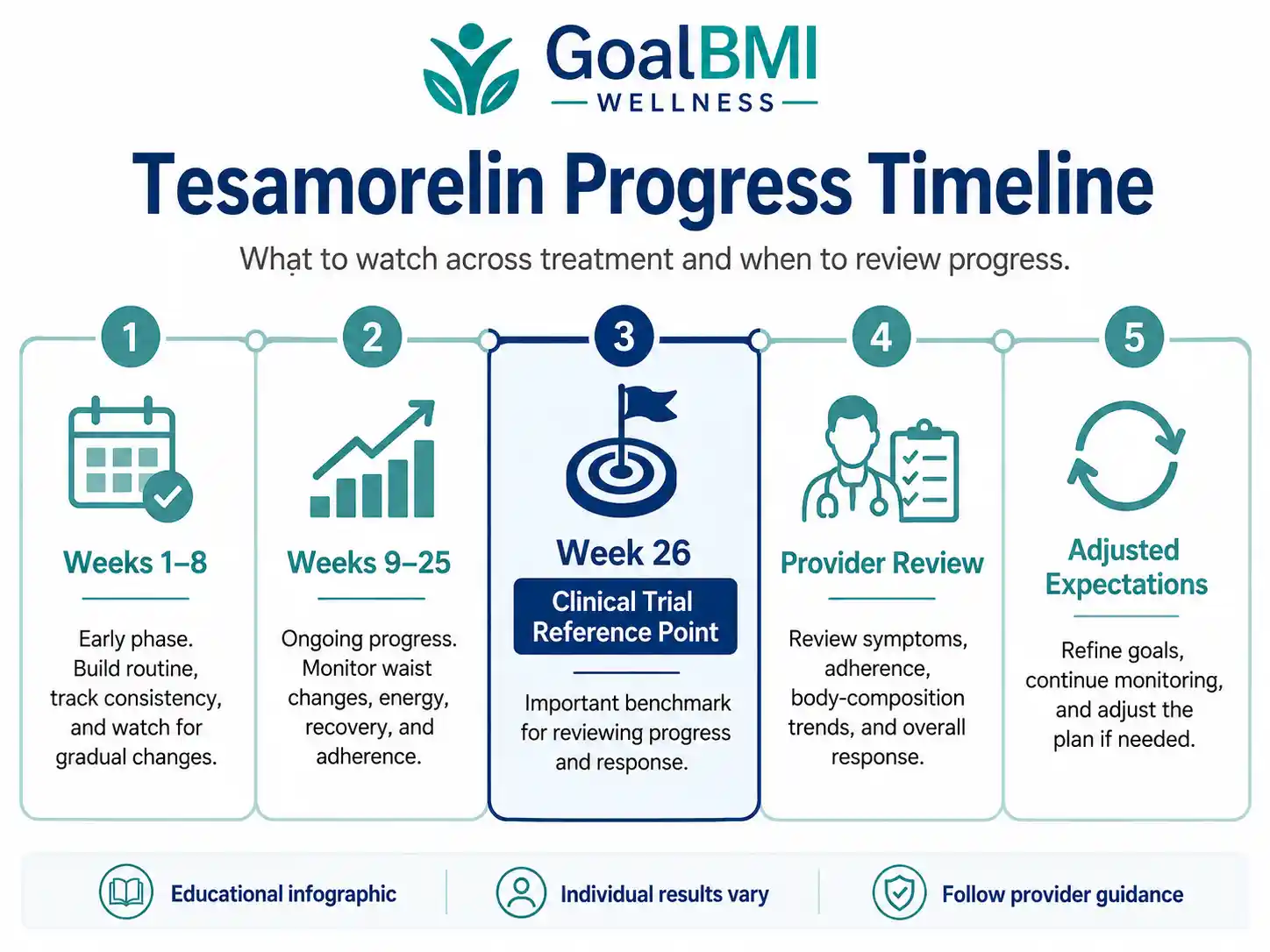
Weeks 1-8: Establishing the Routine
Focus is on tolerance and consistent daily dosing — not yet the window the trials measured.
Weeks 9-25: Building Toward the Data Point
Some patients notice early trends, though the trial’s primary measurement was still ahead.
Week 26 and Beyond: The Reference Point
This is where the clinical trial data is clearest — a useful comparison point for your own progress.
A Simple Tesamorelin Progress Timeline
This illustration shows how the treatment schedule relates to the clinical trial’s own reference point at 26 weeks.
Other Peptide Plateau Guides
How the Trial’s 18% Figure Was Measured
This chart illustrates the pivotal trial result that tesamorelin’s approval and dosing expectations are based on.

What Do Tesamorelin Results Actually Mean?
While tesamorelin’s approved focus is visceral fat reduction, patients often track a wider range of changes.
A plateau in one measure doesn’t mean nothing else is changing. Because tesamorelin’s FDA approval is specific to HIV-associated lipodystrophy, off-label results for other goals are less predictable and less documented — another reason a plateau is worth discussing rather than assuming.
Body Composition
The primary outcome measured in the clinical trials.
Energy
Daytime energy and general vitality some patients report.
Metabolism
General metabolic markers your provider may track.
Healthy Aging
Broader wellness-related goals for off-label use.
How to Track Tesamorelin Progress More Accurately
A simple written record makes it easier to compare your own timeline against the trial’s 26-week reference point.
Rather than judging progress by memory on the day of an appointment, track a small number of measurements consistently and review the trend with your provider.
Body Measurements
Waist measurements, weight, and clothing fit tracked consistently.
Dose Consistency
Note any missed or delayed daily doses.
Energy Levels
Daytime energy and general vitality on a simple scale.
Time Elapsed
How many weeks you’ve been on treatment relative to the 26-week mark.
Reconstitution
Any changes in how your medication is mixed.
Symptoms
Injection-site reactions, joint discomfort, or other new symptoms.
Tesamorelin Progress Review Checklist
This table can help organize the information you may want to discuss during a provider appointment.
| Area to Review | What to Track | What to Discuss |
|---|---|---|
| Time Elapsed | How many weeks you’ve been on treatment | Whether you’re past or still approaching the 26-week trial reference point |
| Dose Consistency | Missed or delayed daily doses | Whether inconsistency may be affecting your comparison to trial data |
| Reconstitution | Any changes in how your medication is mixed | Whether reconstitution method may be relevant |
| Body Composition | Waist measurements, weight, clothing fit | Whether measurements are being taken consistently |
| Energy and Wellness | Daytime energy, motivation, general vitality | Whether off-label goals are showing any change |
| Underlying Health Status | Any recent changes in diagnoses or medications | Whether another factor may be relevant to your response |
| Symptoms or Side Effects | Injection-site reactions, joint discomfort, swelling | Whether symptoms require monitoring or evaluation |
| Original Goal | On-label use vs. off-label goal | Whether expectations remain realistic for your specific situation |
Educational tool only: This checklist does not diagnose a problem or determine whether a dosage adjustment is appropriate. Treatment decisions should be made by the licensed healthcare provider managing your care.
What to Review With Your Provider
Your provider can compare your specific timeline against the clinical trial’s 26-week reference point.
A follow-up review can cover dose consistency, and discuss whether your original goal — on-label or off-label — remains realistic given where you are in treatment.
Treatment History
Review when treatment started and how consistently the daily dose has been followed.
Current Goals
Clarify which outcomes matter most now — on-label or off-label.
Timeline Comparison
Compare your progress against the trial’s 26-week reference point.
Symptoms and Tolerance
Report new symptoms or changes in how treatment is tolerated.
Common Mistakes During a Tesamorelin Plateau
A slower period can be frustrating, but reacting too quickly may make it harder to understand what is actually happening.
A better approach is to step back, compare your timeline against the trial’s reference point, and discuss any concerns with the prescribing provider before changing treatment.
Increasing the Dose Independently
Tesamorelin has an FDA-approved standard dose — never adjust it on your own.
Judging Progress Before Week 26
The trial’s clearest data point was six months in — earlier judgments may be premature.
Missing Daily Doses
Approved dosing is daily; inconsistency can affect how steady progress feels.
Ignoring On-Label vs. Off-Label Distinction
Off-label use has less established data, making realistic expectations harder to set alone.
What to Do When Progress Feels Slower
A plateau is usually a reason to review the plan carefully, not a reason to make aggressive changes on your own.
Check Your Timeline
Compare where you are against the trial’s 26-week reference point.
Review Dose Consistency
Note any missed or delayed daily doses.
Confirm Reconstitution Method
Note any recent changes in how your medication is mixed.
Review Body Measurements
Check waist measurements, weight, and clothing fit against your starting point.
Document New Symptoms
Write down new or worsening symptoms to discuss with the provider.
Schedule a Provider Review
A licensed provider can determine whether your plan should continue or be reassessed.
When Should You Contact Your Provider?
Contact your provider whenever you’re uncertain about your progress relative to the trial timeline.
Progress Feels Different
Your progress relative to the 26-week reference point feels off.
New Symptoms Appear
Report new or worsening symptoms rather than waiting.
Considering a Treatment Change
Speak with the provider before changing your dose or schedule.
Tesamorelin Plateau FAQ
These answers address common questions patients may have when tesamorelin progress becomes less noticeable. Questions about your individual response should be reviewed with your prescribing healthcare provider.
How long before I should expect to see tesamorelin results?
Does my plateau mean tesamorelin has stopped working?
Can missing doses cause a plateau?
Should I increase my dose if I’ve plateaued?
What if I’m using tesamorelin off-label and progress has slowed?
Should I stop tesamorelin if I’m no longer seeing the same results?
Questions About Your Tesamorelin Progress?
If your results feel different than expected, a licensed New York provider can review your treatment timeline, current symptoms, and prescribed plan. A follow-up can help determine whether the current approach should continue or whether additional evaluation may be appropriate.
Schedule a Consultation




-
Monday – Friday:: 9:00 AM – 8:00 PMSaturday:: 9:00 AM – 4:00 PMSunday:: 12:00 PM – 8:00 PM