
GLP-1 Weight Loss Statistics 2026: Semaglutide & Tirzepatide Data, Market Size & Obesity Trends

GLP-1 Weight Loss Statistics 2026: Semaglutide & Tirzepatide Data, Market Size & Obesity Trends
The most comprehensive GLP-1 statistics resource for 2026. Covers US obesity rates, clinical trial outcomes, prescription growth, market data, pricing changes, and what the latest research shows about America’s weight loss transformation.
GLP-1 medications — led by semaglutide (Ozempic®, Wegovy®) and tirzepatide (Mounjaro®, Zepbound®) — have fundamentally transformed the medical weight loss landscape. In 2026, more than 12% of American adults are taking these medications, the US obesity rate has declined from its 2022 peak, and the global market has surpassed $132 billion. This page compiles the most up-to-date statistics, clinical data, and market research available.
US Obesity Statistics 2026
Understanding where America stands on obesity is essential context for GLP-1 prescribing trends. The data in 2026 shows the first meaningful, sustained decline in the US adult obesity rate in decades — a trend directly correlated with increased GLP-1 adoption.
Historic Decline in Progress
After peaking at a record high of 39.9% in 2022, the US adult obesity rate has gradually dropped to 36.4% in 2026 — a statistically meaningful decline that continues to inversely track with increased GLP-1 usage nationally, according to Gallup’s June 2026 survey of 5,065 adults.
This decline represents the first time in modern tracking history that US obesity rates have shown a consistent multi-year downward trend. Researchers have directly attributed this to the widespread adoption of GLP-1 receptor agonists. A full 91% of Americans are now aware of GLP-1 drugs for weight loss — up from 80% in 2024.
Obesity Rates by US State Context
While national obesity rates are declining, significant geographic variation remains. States where GoalBMI Wellness serves patients show particularly high demand for evidence-based medical weight loss programs:
| State | Adult Obesity Rate | Adults with Obesity (Est.) | GLP-1 Access via GoalBMI |
|---|---|---|---|
| New York | 28.1% | ~3.8M | Available ✓ |
| New Jersey | 28.4% | ~2.1M | Available ✓ |
| Pennsylvania | 34.4% | ~3.6M | Available ✓ |
| Connecticut | 28.0% | ~830K | Expanding ✓ |
| National Average | 36.4% | ~100M | — |
GLP-1 Usage Statistics in the US 2026
The number of Americans taking GLP-1 medications has grown at a remarkable pace. What was a relatively niche prescription category just three years ago is now one of the most widely recognized and used drug classes in the country.
Who is Using GLP-1 Medications?
~10 Million Americans Used GLP-1 Medications in 2025
As of 2025, approximately 10 million individuals in the US used GLP-1 medications — a number expected to significantly increase through 2026 and 2027 as pricing becomes more accessible and awareness continues to grow. Source: Forbes Health, 2026
Employer Coverage of GLP-1s Surges
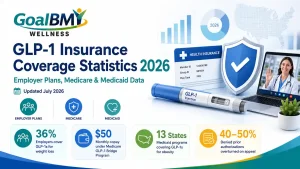
As of 2025, 43% of firms with over 5,000 workers now cover GLP-1 medications for obesity — up from just 28% the prior year. This dramatic expansion of employer coverage is one of the key drivers of increased adoption among working-age Americans.
Medicaid Prescriptions: 1.3M to 8.4M
KFF found that the number of Medicaid prescriptions for GLP-1s increased from 1.3 million in 2019 to 8.4 million in 2024 — a 546% increase. Medicaid gross spending on GLP-1s grew from $1 billion to $8.6 billion over the same period. Source: Pew Research, January 2026
Persistence & Discontinuation Rates
A major clinical concern with GLP-1 medications is long-term adherence. Research from IQVIA tracking over 8.6 million patients shows:
| Metric | GLP-1 for Diabetes | GLP-1 for Obesity |
|---|---|---|
| Continued filling prescriptions after 1 year (retail) | ~72% | ~66.5% |
| Discontinued within 1 year | ~28% | ~33.5% |
| Primary reason for stopping | Side effects / cost | Cost / insurance |
These persistence rates highlight the importance of physician-supervised programs with ongoing monitoring and support — which is a core feature of GoalBMI Wellness telehealth programs.
GLP-1 Market Size & Sales Data 2025–2026
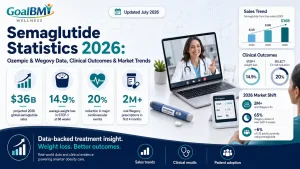
The financial scale of the GLP-1 market is staggering. In 2025 alone, GLP-1 therapies generated approximately $132 billion in global sales — a 33.5% increase from 2024. The anti-obesity market is now the fourth largest pharmaceutical market globally, with a pipeline of 190 obesity-related products in development.
GLP-1 Revenue Growth Trend
190 Obesity Drugs in the Pipeline
According to IQVIA’s 2026 analysis, the obesity drug pipeline now contains 190 products in development — including next-generation GLP-1 combinations, oral formulations, and triple-receptor agonists. The anti-obesity market is expected to continue growing at unprecedented rates into 2027 and beyond. Source: AMCP Annual 2026
Clinical Trial Data: Weight Loss Outcomes
The clinical evidence for GLP-1 and GLP-1/GIP medications is among the strongest ever seen for a pharmacological obesity intervention. Here is what the major trials have shown:
Weight Loss by Medication and Dose
| Medication | Brand Names | Trial | Avg. Weight Loss | Duration | Source |
|---|---|---|---|---|---|
| Tirzepatide (highest dose) | Zepbound® / Mounjaro® | SURMOUNT-1 | ~22.5% | 72 weeks | NEJM 2022 |
| Tirzepatide (average) | Zepbound® / Mounjaro® | SURMOUNT-1 | ~20-21% | 72 weeks | NEJM 2022 |
| Tirzepatide (T2DM patients) | Mounjaro® | SURPASS-2 | ~15% | 40 weeks | NEJM 2021 |
| Semaglutide 2.4mg | Wegovy® | STEP-1 | ~15% | 68 weeks | NEJM 2021 |
| Semaglutide (T2DM) | Ozempic® | STEP-2 | ~10% | 68 weeks | NEJM 2021 |
Weight Loss Progress Over Time — Semaglutide
Understanding how weight loss unfolds over time helps set realistic expectations:
GLP-1 Pricing & Access in 2026
One of the biggest barriers to GLP-1 access has historically been cost. The pricing landscape in 2026 has changed significantly, with new government negotiations and competition making these medications more accessible than ever before.
| Medication | Brand | Previous Monthly Cost | TrumpRx Price (2026) | Oral Version |
|---|---|---|---|---|
| Semaglutide | Ozempic® / Wegovy® | ~$900–$1,300/mo | $245/mo | ✓ Approved Dec 2025 from $149/mo |
| Tirzepatide | Mounjaro® / Zepbound® | ~$1,000–$1,400/mo | $245/mo | In development |
First Oral GLP-1 for Obesity Approved December 2025
In December 2025, the FDA approved an oral formulation of Wegovy (semaglutide) for chronic weight management — the first oral GLP-1 to treat obesity. The starting 1.5 mg dose is available at $149/month for cash-pay patients, significantly lowering the barrier to entry for patients who prefer not to inject. Source: VytlOne, 2026
Insurance Coverage Expansion
As of January 2026, a growing number of state Medicaid plans now cover one or more GLP-1 receptor agonists for obesity treatment under fee-for-service programs. Employer coverage has also expanded dramatically — from 28% to 43% of large employers in just one year.
Key Milestones: The GLP-1 Revolution Timeline
The rise of modern GLP-1 medications for obesity is one of the fastest adoption stories in pharmaceutical history. Here are the key milestones:
What’s Next: GLP-1 Outlook for 2027 and Beyond
The GLP-1 landscape is evolving rapidly. Here are the most important developments to watch in the coming year:
190 Obesity Drugs in the Pipeline
IQVIA’s 2026 analysis identified 190 obesity-related products currently in pharmaceutical development. This includes next-generation GLP-1 combinations, triple agonists, oral formulations, and combination therapies. The competition in this space is expected to drive prices down further and outcomes up significantly.
Retatrutide: 71.2 lbs Average Weight Loss in Trials
Eli Lilly’s experimental triple agonist retatrutide delivered weight loss of up to an average of 71.2 lbs in Phase 2 trials — representing the most dramatic pharmacological weight loss results ever recorded. If approved, it would represent another step-change in outcomes comparable to what tirzepatide was to semaglutide. Source: NEJM, 2023
Telehealth GLP-1 Access Expanding Rapidly
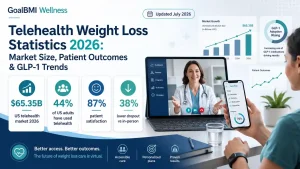
The intersection of telehealth platforms and GLP-1 prescribing is one of the fastest-growing segments of digital health. Physician-supervised telehealth programs — like those offered by GoalBMI Wellness — provide patients with the clinical oversight needed to use these powerful medications safely and effectively, without in-person office visits.
Frequently Asked Questions
Sources & Medical References
This statistics page was compiled from the following peer-reviewed studies, clinical trials, government data, and authoritative research organizations:
- 1Gallup Health Survey (June 2026). “In U.S., GLP-1 Usage Reaches New High.” Survey of 5,065 adults. gallup.com
- 2IQVIA / AMCP Annual Meeting (2026). “GLP-1 drugs to drive growth in obesity and diabetes treatment.” managedhealthcareexecutive.com
- 3Jastreboff A.M. et al. (2022). “Tirzepatide Once Weekly for the Treatment of Obesity (SURMOUNT-1).” New England Journal of Medicine, 387(3), 205–216. doi.org/10.1056/NEJMoa2206038
- 4Frías J.P. et al. (2021). “Tirzepatide versus Semaglutide in Type 2 Diabetes (SURPASS-2).” NEJM, 385(6), 503–515. doi.org/10.1056/NEJMoa2107519
- 5Forbes Health (June 2026). “GLP-1 Statistics & Trends: Usage, Market Size, Pricing & Research 2026.” forbes.com
- 6Pew Research Center (January 2026). “6 facts about obesity and GLP-1 weight loss drugs in the US.” pewresearch.org
- 7KFF (January 2026). State Medicaid coverage of GLP-1s for obesity — fee-for-service analysis.
- 8HLTH.com (April 2026). “GLP-1 Drugs, Digital Health & Obesity Trends in 2026.” hlth.com
- 9U.S. Food & Drug Administration (2023). Zepbound (tirzepatide) prescribing information. accessdata.fda.gov
- 10National Institute of Diabetes & Digestive & Kidney Diseases (2023). Prescription medications to treat overweight & obesity. niddk.nih.gov
- 11VytlOne (March 2026). “The GLP-1 Market in 2026.” vytlone.com



-
Monday – Friday:: 9:00 AM – 8:00 PMSaturday:: 9:00 AM – 4:00 PMSunday:: 12:00 PM – 8:00 PM