Telehealth Only • 480 Court St, Brooklyn, NY 11231
Compounded GLP-1 Statistics 2026 | FDA Crackdown & What Changed
Compounded GLP-1 Statistics 2026: FDA Crackdown, Adverse Events & What Changed | GoalBMI Wellness
📊 Statistics Report — Updated July 2026

Compounded GLP-1 Statistics 2026: FDA Crackdown, Adverse Events & What Changed

Compounded semaglutide and tirzepatide access changed dramatically in 2025–2026. Here’s the current enforcement data, adverse event reports, and what patients need to know about safe, legal treatment options now.

📅 Last Updated: July 2026 ⏱ 11 min read ✔ Physician Reviewed 📚 9 Cited Sources
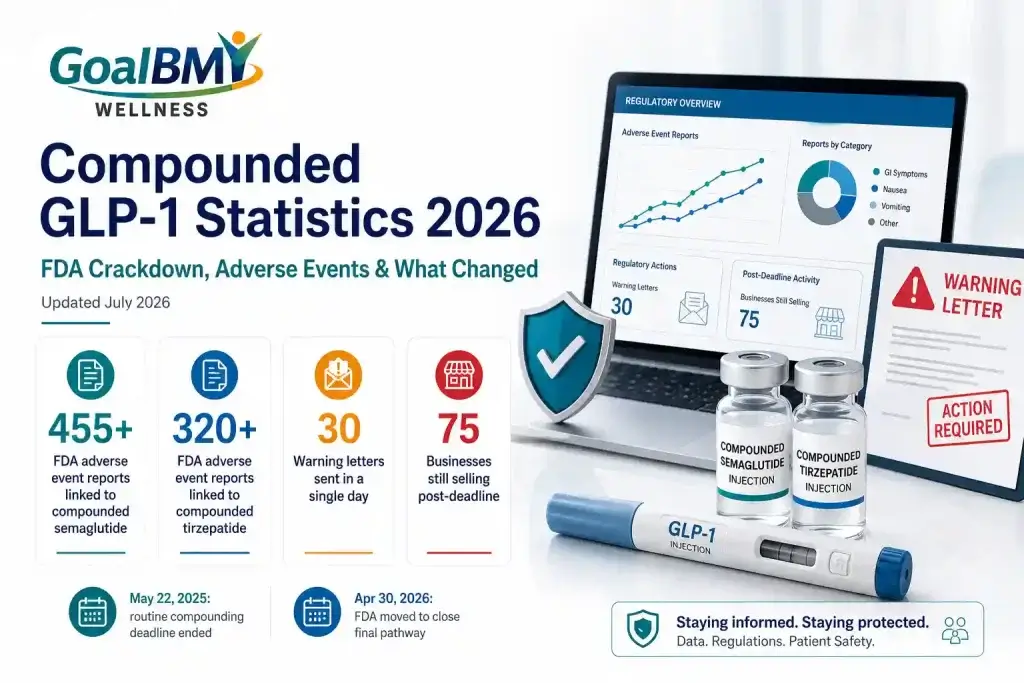
455+
FDA adverse event reports linked to compounded semaglutide
FDA, February 2025
320+
FDA adverse event reports linked to compounded tirzepatide
FDA, February 2025
30
Warning letters sent to telehealth companies in a single day (2026)
FDA, early 2026
75
Businesses found still selling compounded GLP-1s post-deadline
JAMA Health Forum, 2026

For nearly two years, compounded semaglutide and tirzepatide filled a real supply gap while brand-name Ozempic®, Wegovy®, Mounjaro®, and Zepbound® were in shortage. That era is over. The FDA closed the legal pathway for routine compounding of these medications in 2025, and 2026 has brought the most aggressive enforcement campaign this category has seen. Here’s the data on what changed, why, and what it means for anyone still considering a compounded GLP-1.

Section 01

How the Shortage Exemption Actually Ended

Compounding pharmacies are legally permitted to make copies of brand-name drugs only during an official FDA shortage. Once a drug is removed from the shortage list, that legal pathway closes — and it closed for both major GLP-1s within a few months of each other.

Dec 2024
Tirzepatide (Mounjaro®/Zepbound®) removed from the FDA drug shortage list
Feb 2025
Semaglutide (Ozempic®/Wegovy®) removed from the FDA drug shortage list
May 22, 2025
Final deadline — all compounding grace periods officially ended
The phased shutdown: 503A pharmacies (individual compounding pharmacies) lost their enforcement discretion for semaglutide on February 18, 2025. 503B outsourcing facilities (larger-scale compounders) lost theirs on March 19, 2025. By May 22, 2025, the FDA prohibited distribution of compounded forms of both drugs entirely. (Source: Portrait Care, June 2026)
⚖️

Legal Challenges Failed to Stop the Shutdown

The Outsourcing Facilities Association filed federal lawsuits challenging both the tirzepatide and semaglutide shortage-resolution determinations. Courts denied preliminary injunctions in each case, and the enforcement deadlines held as scheduled. (Source: Pharmacy Times, July 2026)


Section 02

April 2026: The FDA Moves to Close the Last Legal Pathway

Even after the shortage exemption ended, a narrow legal pathway remained — compounding for documented “clinical need” cases. In 2026, the FDA moved to eliminate even that.

🚫

Semaglutide, Tirzepatide, and Liraglutide Proposed for Permanent Exclusion

On April 30, 2026, the FDA proposed permanently excluding semaglutide, tirzepatide, and liraglutide from the “503B Bulks List” — the list of ingredients large-scale compounding facilities are legally permitted to use. If finalized, this closes the last remaining legal pathway for most compounded versions of these drugs. (Source: Stanford Medicine, July 2026)

The FDA’s stated position: “When FDA-approved drugs are available, outsourcing facilities cannot lawfully compound using bulk drug substances unless there is a clear clinical need.” Compounding is meant to fill genuine gaps — such as a patient needing a different dose or formulation for documented medical reasons — not to offer a cheaper copy of a fully available brand-name drug. (Source: Pharmacy Times, 2026)

Why This Matters: Compounded Isn’t the Same Molecule

The semaglutide and tirzepatide in FDA-approved drugs have specific chemical structures tested extensively across large clinical trials. Some compounders instead use chemically distinct salt forms of these molecules — versions that have not gone through the same rigorous safety and efficacy testing as the approved product, even though they may be marketed as equivalent. (Source: Stanford Medicine, 2026)


Section 03

The 2026 Enforcement Crackdown, by the Numbers

The FDA hasn’t just changed the rules on paper — it has actively pursued enforcement against companies still selling compounded GLP-1s after the deadlines passed.

30
Telehealth companies sent warning letters in a single day, early 2026
75
Businesses found still selling compounded GLP-1s (Aug–Oct 2025 study)
95.6%
Of those businesses held an active state pharmacy license
13%
Were registered with the FDA as outsourcing facilities
FDA Adverse Event Reports Linked to Compounded GLP-1s (as of Feb 2025)
Source: FDA / Harris Beach Murtha, 2025. Reports include dosing errors from patients self-administering incorrect doses from multidose vials.
🕵️

A “Secret Shopper” Study Found Ongoing Sales Months After the Deadline

Researchers acting as secret shoppers, publishing in JAMA Health Forum, identified 75 businesses across two states still offering compounded obesity medications for sale between August and October 2025 — months after the FDA’s distribution ban took effect. One researcher noted the findings show “how difficult it is for the FDA to regulate compounding for obesity drugs” in practice. (Source: Healio, July 2026)

⚠️

Counterfeit Products Entered the Market During the Shortage

Beyond legitimate compounding, the shortage period saw counterfeit GLP-1 products flood online channels — frequently manufactured abroad without any state licensure or regulatory oversight. Eli Lilly separately pursued legal action against clinics using its trademarked names (“Zepbound,” “Mounjaro”) to market compounded products that were not the real, FDA-approved medications. (Source: Harris Beach Murtha, 2025)


Section 04

What Legal, Affordable Options Actually Exist Now

The end of routine compounding doesn’t mean patients are left with only expensive, uncovered options. Several legitimate pathways have expanded specifically because compounding closed.

OptionWhat It IsStatus in 2026
Brand-name GLP-1sOzempic®, Wegovy®, Mounjaro®, Zepbound®Widely available — shortage resolved
Manufacturer savings programsDirect-from-manufacturer discount pricingActive — as low as $245/month via TrumpRx
Medicare GLP-1 Bridge Program$50/month copay for eligible beneficiariesLive since July 1, 2026
Legitimate clinical-need compoundingDocumented medical reason for a different dose/formulationNarrow, provider-determined exception
Routine compounded copiesStandard-dose compounded semaglutide/tirzepatideNo longer a legal routine pathway
The bottom line for patients: “Don’t panic” is the right response, according to multiple industry analyses — legal, affordable options exist through manufacturer savings programs, the new TrumpRx pricing structure, and direct-pay clinics. The right move is comparing branded GLP-1 costs against savings programs before assuming treatment is unaffordable, and avoiding any pharmacy still advertising routine compounded semaglutide or tirzepatide without a documented clinical justification. (Source: Health Facts Journal, May 2026)

Program Access

How GoalBMI Wellness Approaches This Shift

GoalBMI Wellness prescribes FDA-approved brand-name GLP-1 medications when clinically appropriate, with insurance verification and transparent self-pay pricing reflecting current, legal pricing structures — not routine compounded copies of a fully available drug.

GoalBMI Wellness transparent GLP-1 pricing — insurance and self-pay options for brand-name semaglutide and tirzepatide

Real Patient Outcomes

Before & After — Results With Legitimate, Supervised Treatment

These results are from real GoalBMI Wellness patients treated with FDA-approved medications under physician supervision — the safer, legally sound alternative to unregulated compounded sourcing.

Before and after semaglutide and tirzepatide weight loss results — GoalBMI Wellness physician-supervised patients

See more patient before & after results →

Results disclaimer: Individual results may vary. Photos represent real patients from physician-supervised GoalBMI Wellness programs shared with patient consent. Results depend on individual health factors, program adherence, and clinical evaluation.


Section 05

Compounded GLP-1 Regulation Timeline, 2024–2026

December 2024
Tirzepatide Shortage Resolved
The FDA removes tirzepatide (Mounjaro®/Zepbound®) from its official drug shortage list, starting the clock on compounding wind-down deadlines.
February 2025
Semaglutide Shortage Resolved; 503A Deadline Hits
Semaglutide (Ozempic®/Wegovy®) is removed from the shortage list. The same month, 503A compounding pharmacies lose their enforcement discretion for semaglutide (February 18). FDA reports 455+ adverse events linked to compounded semaglutide and 320+ linked to compounded tirzepatide to date.
March 19, 2025
503B Outsourcing Facilities Lose Discretion
Larger-scale 503B compounding facilities lose their enforcement discretion for semaglutide, tightening the legal pathway further.
April 24, 2025
Court Denies Injunction
A federal court denies the Outsourcing Facilities Association’s preliminary injunction motion challenging the FDA’s semaglutide shortage determination, clearing the way for enforcement deadlines to proceed as scheduled.
May 22, 2025
Final Compounding Deadline
The FDA prohibits distribution of compounded forms of both semaglutide and tirzepatide after this date, ending the routine compounding pathway nationwide.
Aug–Oct 2025
Secret Shopper Study Finds Ongoing Sales
A JAMA Health Forum study identifies 75 businesses across two states still offering compounded obesity medications for sale, months after the legal deadline.
Early 2026
FDA Sends 30 Warning Letters in One Day
The FDA launches its most aggressive enforcement campaign yet against telehealth companies and compounders still offering compounded GLP-1s without a documented clinical need.
April 30, 2026
Permanent Exclusion Proposed
The FDA proposes permanently excluding semaglutide, tirzepatide, and liraglutide from the 503B Bulks List — the final step toward closing the last legal compounding pathway, pending formal finalization.
July 2026
Ongoing Enforcement Continues
Regulatory attention remains active, with continued monitoring of telehealth companies and compounding pharmacies for compliance as the 503B Bulks List exclusion moves through formal rulemaking.

Section 06

Frequently Asked Questions

For routine dispensing, no. The FDA ended the shortage-based compounding exemption for both drugs by May 22, 2025. Compounding remains legally possible only in narrow cases involving a documented clinical need — such as a specific dosing requirement a brand-name product can’t meet — determined by a licensed provider, not as a general lower-cost alternative.
Compounding is legally permitted during an official FDA drug shortage to fill a genuine supply gap. Once tirzepatide (December 2024) and semaglutide (February 2025) were removed from the shortage list, that legal basis ended. The FDA also cited 455+ adverse event reports for compounded semaglutide and 320+ for compounded tirzepatide, many involving dosing errors from multidose vials, plus concerns about counterfeit products entering the market.
Not necessarily. FDA-approved drugs use specific chemical structures tested extensively in clinical trials. Some compounders have used chemically distinct salt forms of semaglutide or tirzepatide, which have not undergone the same rigorous safety and efficacy testing — even when marketed as equivalent to the approved product.
Exercise real caution. A 2026 study found 75 businesses still selling compounded obesity medications months after the legal deadline, and the FDA has sent 30 warning letters in a single day to telehealth companies for non-compliance. Ask specifically whether there is a documented clinical need for compounding in your case, or whether it’s being offered as a routine, lower-cost alternative — which is no longer a legal basis for most patients.
Several legitimate pathways have expanded specifically in response: manufacturer savings programs and the TrumpRx pricing structure cap brand-name GLP-1 costs at roughly $245/month, and eligible Medicare beneficiaries can access the GLP-1 Bridge Program at a $50 monthly copay as of July 2026. Insurance verification is also worth doing before assuming a brand-name medication is unaffordable — coverage expanded meaningfully compared to a few years ago.
References

Sources & References

  • 1Healio (July 2026). Compounded semaglutide, tirzepatide continued to be sold after shortages ended. healio.com
  • 2FDA (2025–2026). FDA clarifies policies for compounders as national GLP-1 supply begins to stabilize. fda.gov
  • 3Pharmacy Times (July 2026). FDA Moves to Permanently Close the Door on Compounded GLP-1s. pharmacytimes.com
  • 4GoodRx (2025). Are Compounded GLP-1s Going Away? Not Entirely. goodrx.com
  • 5Stanford Medicine (July 2026). Compounded GLP-1s: Why doctors worry and the FDA is cracking down. med.stanford.edu
  • 6Portrait Care (June 2026). 2026 FDA Rules and News for Compounded Tirzepatide. portraitcare.com
  • 7Harris Beach Murtha (2025). GLP-1 Weight-Loss Drugs Off Shortage List; Deadlines to Stop Compounding. harrisbeachmurtha.com
  • 8Health Facts Journal (May 2026). Compounded GLP-1 And The FDA Shortage List: 2026 Update. healthfactsjournal.com
  • 9Lincoff A.M. et al. (2023). Semaglutide and Cardiovascular Outcomes in Obesity without Diabetes (SELECT). NEJM 389, 2221–2232. doi.org/10.1056/NEJMoa2307563
KM

Medically Reviewed by Karla K. Mioduchoski, FNP-BC

Board-Certified Family Nurse Practitioner — GoalBMI Wellness

Karla K. Mioduchoski, FNP-BC is a board-certified Family Nurse Practitioner providing physician-supervised medical weight loss, GLP-1 support, peptide therapy, and telehealth wellness care through GoalBMI Wellness. All regulatory data in this article was reviewed for accuracy in July 2026.
Regulatory & Medical Disclaimer: This content is for informational purposes only and does not constitute medical or legal advice. Regulatory status described here reflects publicly available FDA information as of July 2026 and is subject to change as rulemaking proceeds. GoalBMI Wellness prescribes FDA-approved brand-name medications when clinically appropriate, following evaluation by a licensed provider. Always confirm current medication sourcing and safety information directly with your provider. In a medical emergency, call 911.
Get Started

Book an appointment and take the first step toward better health.

Book Now
Working Time
  • Monday – Friday:: 9:00 AM – 8:00 PM
    Saturday:: 9:00 AM – 4:00 PM
    Sunday:: 12:00 PM – 8:00 PM