Telehealth Only • 480 Court St, Brooklyn, NY 11231
Peptide Therapy Statistics 2026 | Market Growth & FDA Regulation Update
Peptide Therapy Statistics 2026: Market Growth, Regulation & Patient Trends | GoalBMI Wellness
📊 Statistics Report — Updated July 2026

Peptide Therapy Statistics 2026: Market Growth, Regulation & Patient Trends

A data-backed look at the fast-growing peptide therapy landscape in 2026 — market size, the most requested peptides, the FDA’s ongoing compounding reclassification, and what programs typically cost.

📅 Last Updated: July 2026 ⏱ 11 min read ✔ Physician Reviewed 📚 10 Cited Sources
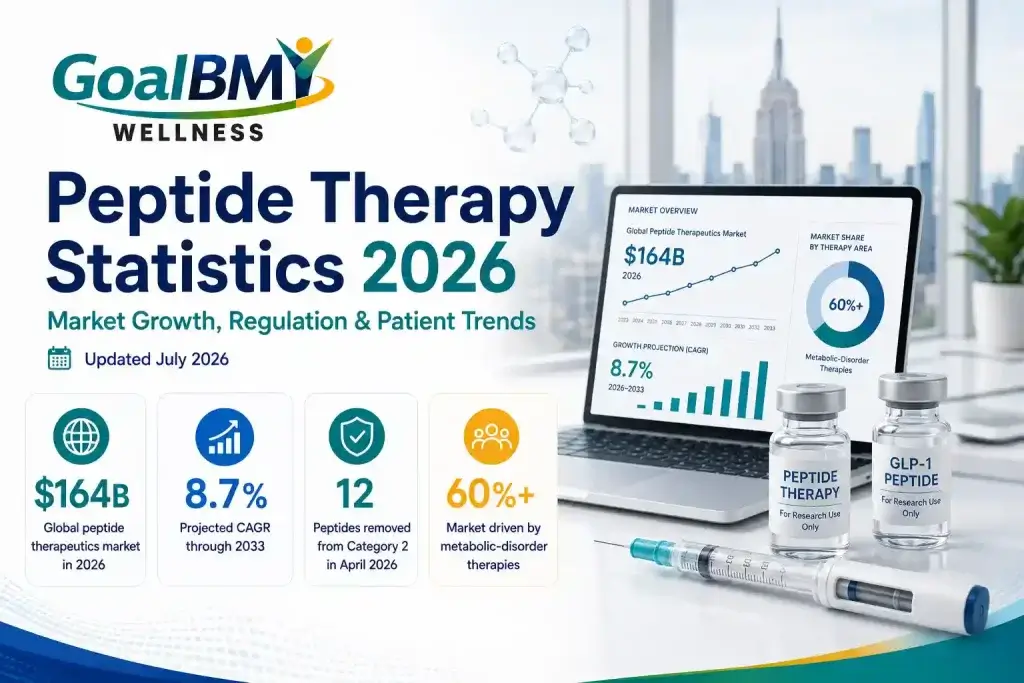
$164B
Global peptide therapeutics market value in 2026
Grand View Research, 2026
8.7%
Projected annual growth rate (CAGR) through 2033
Grand View Research, 2026
14
Peptides expected to return to compoundable Category 1 status
HHS / FDA, April 2026
60%+
Of the peptide market driven by metabolic-disorder therapies
Roots Analysis, 2026

Peptide therapy has moved from a niche wellness trend to a genuine growth segment of medicine — driven largely by GLP-1 obesity treatments, but extending into recovery, healthy aging, and hormone-support peptides like CJC-1295 and Sermorelin. At the same time, 2026 has brought the most significant regulatory shake-up this category has seen in years. This page compiles the current market data, patient demand patterns, and — critically — the regulatory status patients need to understand before starting any peptide program.

Section 01

How Large Is the Peptide Therapeutics Market in 2026?

Peptide-based medicine has become one of the fastest-growing categories in pharmaceuticals, and estimates vary by methodology but agree on the direction: rapid, sustained growth.

$164B
Global peptide therapeutics market value in 2026, per Grand View Research
8.9%
CAGR projected by another major analysis through 2035
2nd
Peptides projected to become the second-largest drug class by revenue after antibodies
Peptide Therapeutics Market Value, 2025–2033 (USD Billions)
Source: Grand View Research, 2026. Figures vary across research firms depending on methodology, but the growth trend is consistent.
🏭

Manufacturing Capacity Is the Real Bottleneck

Analysts at Evaluate Pharma project the market will reach roughly $85 billion by 2030 on some estimates. One industry analyst noted the peptide manufacturing workforce needs to triple by 2028 to keep pace with GLP-1 demand alone — production capacity, not patient demand, is the binding constraint on this market’s growth. (Source: PeptideStaff, April 2026)

Why metabolic disorders dominate: Metabolic-disorder peptides — chiefly GLP-1 and GIP receptor agonists for obesity and diabetes — account for over 60% of the entire peptide therapeutics market. Subcutaneous injection is the dominant route of administration industry-wide, reflecting how deeply GLP-1 therapies now shape the category. (Source: Roots Analysis, 2026)

Section 02

Which Peptides Are Patients Actually Requesting?

Beyond GLP-1s, a distinct wellness-and-recovery peptide category has grown steadily — led by growth-hormone-releasing peptides and tissue-repair compounds.

~10%
Combined demand share for CJC-1295 (no DAC) + Ipamorelin protocols
~8%
Demand share for BPC-157, the most-requested recovery peptide
~4%
Demand share each for GLOW blend and TB-500
Approximate Peptide Demand Share, 2026
Source: Cernum Biosciences Peptide Statistics, 2026. Figures reflect relative purchase volume across a sampled consumer base, not clinical prescribing data.
📈

Sermorelin, Ipamorelin, and CJC-1295 Are Frequently Grouped Together

Among peptides marketed for muscle development and recovery support, Sermorelin, Ipamorelin, and CJC-1295 are the most frequently discussed as a group, often compared informally to growth hormone therapy. BPC-157 remains the leading choice specifically for tissue-repair and recovery-focused protocols. (Source: Peptides270, 2026)

A long tail of additional peptides — including GHK-Cu, Tesamorelin, and others — each represent a smaller but consistent share of patient interest, reflecting a market that has diversified well beyond weight management alone.


Section 03

The 2026 FDA Compounding Reclassification — What’s Actually Changed

This is the single most important development for peptide patients in 2026, and it is frequently misunderstood. Here is what the data actually shows.

The core fact patients need to understand: On April 15, 2026, HHS Secretary Kennedy confirmed the removal of 12 peptides from FDA Category 2 — including BPC-157, TB-500, MOTS-C, GHK-Cu (injectable), and CJC-1295 — following withdrawal of their nominations to that restricted category. This does not mean these peptides are now FDA-approved or legal to compound. Removal from Category 2 does not automatically confer Category 1 (compoundable) status. (Source: BSCG, May 2026)
12
Peptides removed from Category 2 in April 2026
Jul 23-24
2026 — PCAC meeting date to begin formal peptide review
~14
Peptides expected to eventually return to Category 1, per multiple sources
~5
Peptides expected to remain restricted over safety concerns

Formal Rulemaking Is Still Required — Nothing Changed Overnight

The FDA requires formal rulemaking before compounding pharmacies may legally act on a reclassification, even after a favorable Pharmacy Compounding Advisory Committee (PCAC) review. A pharmacy compounding attorney described this as “the initiation of a long regulatory process,” not an immediate change. Sourcing, batch validation, and sterility testing all take additional time after any rule change. (Source: Pharmacy Times, July 2026)

Why These Peptides Were Restricted in the First Place

The FDA’s original 2023 Category 2 placements cited specific, recurring concerns:

PeptideCited FDA ConcernApril 2026 Status
BPC-157Immunogenicity risk, impurities, limited human dataRemoved from Cat. 2
TB-500Impurity and API characterization concernsRemoved from Cat. 2
CJC-1295Reported heart-related effects; impurity concernsRemoved from Cat. 2
MOTS-CSignificant immunogenicity risk for some routesRemoved from Cat. 2
Melanotan II, GHRP-2/6, LL-37, PEG-MGFOngoing safety concernsExpected to remain restricted

Note: “Removed from Category 2” is not the same as FDA-approved or cleared for compounding. Category 1 reclassification requires individual PCAC review and formal FDA rulemaking, which had not concluded as of this page’s last update.

Important distinction that hasn’t changed: Reclassification governs compounding legality only. It does not confer FDA approval, an established benefit-risk profile, or standardized dosing — none of these peptides have completed the Phase 1–3 clinical trial process the FDA requires for drug approval. (Source: Pharmacy Times, 2026)

WADA and Military Restrictions Remain Unchanged

Separately from FDA compounding status, BPC-157, TB-500, and CJC-1295 remain prohibited under the 2026 World Anti-Doping Agency Prohibited List, effective January 1, 2026, and remain restricted under strict military liability rules. FDA compounding discussions have no bearing on WADA or military status. (Source: BSCG, 2026)


Section 04

What Do Peptide Therapy Programs Typically Cost?

Cost varies enormously depending on the peptide, the source, and whether it’s dispensed through a licensed compounding pharmacy under a valid prescription versus purchased as an unregulated “research” product.

PeptideCompounding Pharmacy (Monthly)Brand-Name (Monthly)
CJC-1295 (no DAC)$150 – $350N/A
Sermorelin$200 – $400N/A (generic available)
Ipamorelin$150 – $300N/A
Tesamorelin$300 – $500$800 – $1,500+
Semaglutide$200 – $500$900 – $1,400+
Tirzepatide$300 – $600$1,000 – $1,500+
⚠️

“Research Grade” Pricing Reflects an Unsafe, Unsupervised Market

Some sources list “research grade” per-vial pricing as low as $20–$70 for these same peptides — dramatically cheaper than compounding pharmacy pricing. This price gap exists precisely because research-grade products bypass prescription requirements, physician oversight, and pharmacy quality controls entirely. The lower price reflects the absence of the safety infrastructure a licensed program provides, not a better deal. (Source: Peptide Labs, 2026)

Federal enforcement is active: The Department of Justice prosecuted one compounding operation for distributing unapproved peptides — including BPC-157 — resulting in a $1.79 million forfeiture. This underscores that unregulated peptide sourcing carries real legal and safety exposure, not just a theoretical risk. (Source: Holt Law, 2026)

Program Access

Physician-Guided Peptide Therapy at GoalBMI Wellness

Given the regulatory complexity and safety concerns outlined above, sourcing matters as much as the peptide itself. GoalBMI Wellness provides evaluation-first, physician-guided peptide therapy through licensed New York providers — never unsupervised or unprescribed.

GoalBMI Wellness physician-guided peptide therapy programs — New York telehealth pricing and insurance options

Real Patient Outcomes

Before & After — Real Results at GoalBMI Wellness

These results are from real GoalBMI Wellness patients in physician-supervised peptide and GLP-1 programs — the kind of clinically monitored care this page recommends over unregulated, unsupervised sourcing.

Before and after weight loss and wellness results — GoalBMI Wellness physician-supervised patients

See more patient before & after results →

Results disclaimer: Individual results may vary. Photos represent real patients from physician-supervised GoalBMI Wellness programs shared with patient consent. Results depend on individual health factors, program adherence, and clinical evaluation.


Section 05

2023–2026 Peptide Regulation Timeline

2023
FDA Places 19 Peptides in Category 2
The FDA assigns 19 peptides — including BPC-157, TB-500, and CJC-1295 — to Category 2 of the 503A bulk substances list, citing immunogenicity risk, impurities, and limited human safety data. This effectively prohibits licensed 503A pharmacies from compounding them.
2023–2025
Demand Shifts Into Unregulated Channels
Restricted compounding access pushes patient demand toward unregulated “research peptide” sellers, increasing exposure to impurity, dosing, and legal risk outside licensed medical supervision.
February 2026
Reclassification Discussion Goes Public
HHS Secretary Kennedy discusses FDA peptide restrictions publicly, signaling potential reclassification review for several Category 2 peptides.
April 15, 2026
12 Peptides Removed From Category 2
HHS confirms removal of 12 peptides — including BPC-157, TB-500, MOTS-C, GHK-Cu (injectable), and CJC-1295 — from Category 2, following withdrawal of their nominations. This does not move them to Category 1.
July 23–24, 2026
PCAC Begins Formal Review
The Pharmacy Compounding Advisory Committee holds its first meeting to begin evaluating specific peptides for potential Category 1 reclassification — the start of a process expected to take significant additional time before any compounding changes take effect.
Ongoing
Formal Rulemaking Still Required
Even with a favorable PCAC recommendation, formal FDA rulemaking, raw-material sourcing, and batch/sterility validation must all occur before compounding pharmacies can legally act on any reclassification.

Section 06

Frequently Asked Questions

Estimates vary by research firm, but Grand View Research values the global peptide therapeutics market at approximately $164 billion in 2026, growing at a compound annual growth rate of roughly 8.7% through 2033. Other analyses project the market could approach $85 billion by 2030 on more conservative growth assumptions. All major estimates agree the category is expanding rapidly, driven primarily by GLP-1 metabolic therapies.
No. Removal from FDA Category 2 in April 2026 means CJC-1295 is no longer explicitly flagged as a “substance with safety concerns” for compounding purposes, but it has not been moved to Category 1 (the list of substances permitted for compounding) and remains not FDA-approved for any human indication. Formal rulemaking and individual Pharmacy Compounding Advisory Committee review are still required before this could change.
Beyond GLP-1 therapies, CJC-1295 (no DAC) combined with Ipamorelin represents roughly 10% of tracked peptide demand, with BPC-157 — the leading recovery-focused peptide — at approximately 8%. Sermorelin, Tesamorelin, GLOW blend, and TB-500 each maintain smaller but consistent shares of overall interest.
Research-grade peptides bypass prescription requirements, physician oversight, and pharmacy-level quality and sterility controls — which is precisely why they cost less. Licensed compounding pharmacy pricing reflects the safety infrastructure of a valid prescription, quality-controlled sourcing, and medical supervision. The Department of Justice has prosecuted at least one operation for distributing unapproved peptides, including a case resulting in a $1.79 million forfeiture.
No. FDA compounding reclassification is entirely separate from World Anti-Doping Agency (WADA) and military restrictions. BPC-157, TB-500, and CJC-1295 all remain prohibited under the 2026 WADA Prohibited List, effective January 1, 2026, and remain restricted under military strict-liability rules regardless of their FDA compounding category.
References

Sources & References

  • 1Grand View Research (June 2026). Peptide Therapeutics Market Size & Share Report, 2026–2033. grandviewresearch.com
  • 2Roots Analysis (June 2026). Peptide Therapeutics Market Size, 2035. rootsanalysis.com
  • 3PeptideStaff (April 2026). Peptide Therapy Market Forecast 2026: Growth Drivers and Outlook. peptidestaff.com
  • 4Cernum Biosciences (May 2026). Peptide Statistics 2026. cernumbiosciences.com
  • 5BSCG (May 2026). What’s Changing With Peptide Regulation in 2026. bscg.org
  • 6Pharmacy Times (July 2026). The Peptide Reclassification Everyone’s Talking About: A Pharmacist’s Take. pharmacytimes.com
  • 7BioSpace (April 2026). FDA Mulls Compounding for Peptides Previously Flagged Over Safety Risks. biospace.com
  • 8New Drug Loft / VLS Pharmacy (May 2026). Regulatory Updates on Compounded Peptides. newdrugloft.com
  • 9Holt Law (2026). The Unregulated World of Peptides: What You Need to Know Before You Inject. djholtlaw.com
  • 10Peptide Labs (2026). Peptide Therapy Cost: What to Expect in 2026. peptidelabsinc.com
KM

Medically Reviewed by Karla K. Mioduchoski, FNP-BC

Board-Certified Family Nurse Practitioner — GoalBMI Wellness

Karla K. Mioduchoski, FNP-BC is a board-certified Family Nurse Practitioner providing physician-supervised peptide therapy, medical weight loss, and telehealth wellness care through GoalBMI Wellness. All regulatory and market data in this article was reviewed for accuracy in July 2026.
Medical & Regulatory Disclaimer: This content is for informational and educational purposes only and does not constitute medical, legal, or financial advice. Regulatory status described here reflects publicly available information as of July 2026 and is subject to change as FDA rulemaking proceeds. Many peptides discussed on this page, including CJC-1295, are not FDA-approved for any human indication; some may be prescribed off-label or dispensed through licensed 503A compounding pharmacies where clinically appropriate and permitted. Always confirm current regulatory status and safety information with a licensed healthcare provider before starting any peptide therapy. In a medical emergency, call 911.
Get Started

Book an appointment and take the first step toward better health.

Book Now
Working Time
  • Monday – Friday:: 9:00 AM – 8:00 PM
    Saturday:: 9:00 AM – 4:00 PM
    Sunday:: 12:00 PM – 8:00 PM