
Bariatric Surgery vs. GLP-1 Statistics 2026 | Head-to-Head Data
Bariatric Surgery vs. GLP-1 Statistics 2026: What the Head-to-Head Data Shows
A balanced look at the largest real-world comparisons between metabolic and bariatric surgery and GLP-1 medications — weight loss outcomes, cost, durability, and why the two are increasingly discussed as options along the same care pathway rather than competitors.
Patients considering significant weight loss increasingly ask the same question: surgery or medication? In 2026, several of the largest real-world studies ever conducted directly compared the two. The honest answer from this data is that surgery currently produces greater average weight loss and better durability — but the story is more nuanced than a simple winner. Discontinuation, cost, invasiveness, and individual clinical circumstances all shape which option actually fits a given patient.
The Largest Real-World Comparison to Date
In May 2026, investigators from Yale School of Medicine, Vanderbilt University, UT Health San Antonio, and Coreva-Scientific presented what may be the most comprehensive comparison yet at the ASMBS Annual Meeting.
Weight Loss Outcomes, Side by Side
Multiple independent studies converge on a similar magnitude of difference, even though methodologies vary.
A Claims-Based Study of 30,458 Patients
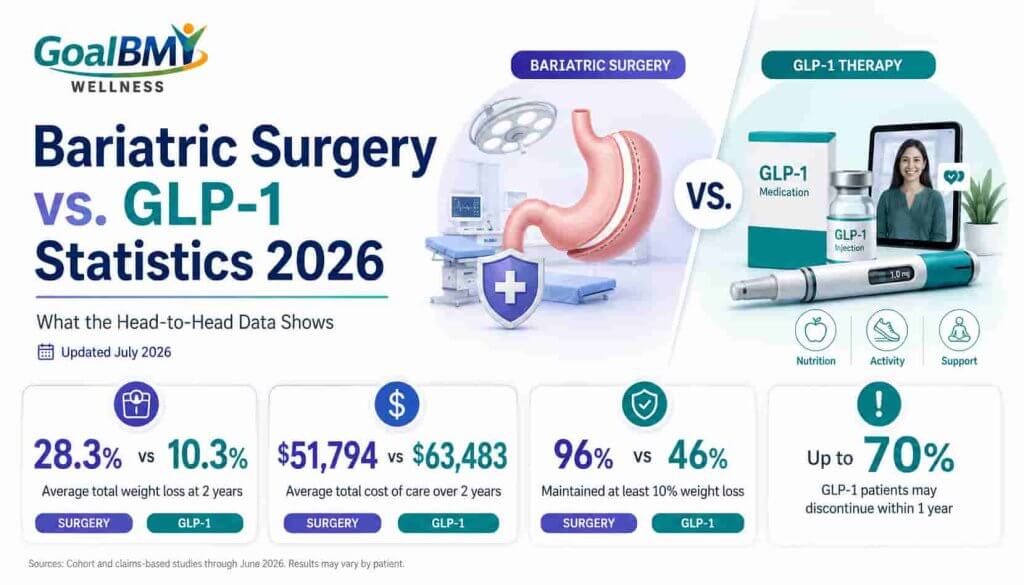
A retrospective cohort study using insurance claims and electronic health records compared 14,101 bariatric surgery patients (mean follow-up 34 months) against 16,357 GLP-1 patients (mean follow-up 32 months), all with class II or III obesity. After 2 years, surgery patients averaged 28.3% total weight loss versus 10.3% for GLP-1 patients. Surgery patients were also far more likely to sustain results: 96% maintained at least 10% weight loss, compared to 46% in the GLP-1 group. (Source: PMC / JAMA Surgery, 2025)
An NYU Langone Study Found a Five-Fold Difference
A separate head-to-head real-world study from NYU Langone Health and NYC Health + Hospitals found patients who underwent bariatric surgery lost an average of 58 pounds after two years, compared with 12 pounds for patients on a GLP-1 prescription for at least six months — roughly five times more weight loss with surgery. (Source: ASMBS, June 2025)
Why the Gap Is Partly About Adherence, Not Just the Drug
The most important context for these numbers is one the lead researchers themselves emphasized: much of the observed gap reflects how GLP-1 therapy is actually used in the real world, not a ceiling on what the medication can achieve.
Up to 70% of GLP-1 Patients May Discontinue Within a Year
Lead study author Dr. Avery Brown of NYU Langone Health noted: “as many as 70% of patients may discontinue treatment within one year.” Patients who stayed on continuous GLP-1 therapy for a full year lost meaningfully more weight than those who didn’t — still less than surgery patients, but the researchers were explicit that adherence changes the picture substantially. (Source: ASMBS, 2025)
Cost Over Time: A Less Intuitive Result
One of the more counterintuitive 2025–2026 findings involves total cost of care, not just upfront price.
| Measure (2-Year Window) | Bariatric Surgery | GLP-1 Therapy |
|---|---|---|
| Average total cost of care | $51,794 | $63,483 |
| Average total weight loss | 28.3% | 10.3% |
| Sustained ≥10% weight loss | 96% of patients | 46% of patients |
Bariatric Surgery Volumes Are Actually Declining
Despite the outcome data above, the number of bariatric procedures performed nationally has been falling — a trend directly tied to GLP-1 adoption.
Sequential Treatment Is Increasingly Common — And Works Well
A separate 2026 analysis found that patients who started on GLP-1 therapy and later transitioned to bariatric surgery — whether due to side effects, medication unavailability, or seeking definitive treatment — had surgical outcomes and quality-of-life scores comparable to patients who went straight to surgery. Prior GLP-1 use was not associated with worse surgical results. (Source: Surgery for Obesity and Related Diseases, 2026)
Where GLP-1 Therapy Fits at GoalBMI Wellness
This data doesn’t argue against GLP-1 therapy — it argues for the structured, physician-supervised approach that helps patients stay on treatment long enough to see the results clinical trials demonstrate are achievable. GoalBMI Wellness provides exactly that: ongoing dose management, follow-up, and support designed around the adherence gap this research identifies.

Before & After — Supervised GLP-1 Results at GoalBMI Wellness
Continuous adherence is the single biggest factor separating patients who see meaningful results from those who don’t. These results reflect physician-supervised patients supported through the full course of treatment.

See more patient before & after results →
Results disclaimer: Individual results may vary. Photos represent real patients from physician-supervised GoalBMI Wellness programs shared with patient consent. Results depend on individual health factors, program adherence, and clinical evaluation.
How the Comparison Evolved, 2020–2026
Frequently Asked Questions
Sources & References
- 1American Society for Metabolic and Bariatric Surgery (May 6, 2026). Bariatric Surgery Significantly More Effective Than GLP-1 Drugs for Weight Loss and Disease Remission. asmbs.org
- 2American Society for Metabolic and Bariatric Surgery (June 17, 2025). Head-to-Head Study Shows Bariatric Surgery Superior to GLP-1 Drugs for Weight Loss. asmbs.org
- 3American Academy of Ophthalmology / PMC (December 2025). Obesity Treatment With Bariatric Surgery vs GLP-1 Receptor Agonists. pmc.ncbi.nlm.nih.gov
- 4Sabatella V. et al. (2026). Comparative Efficacy of Metabolic/Bariatric Surgery Versus GLP-1 Receptor Agonists: A Network Meta-Analysis of RCTs. Obesity 34(4), 770–781. doi.org/10.1002/oby.70100
- 5Healthline (May 11, 2026). Bariatric Surgery vs. GLP-1 Drugs: Which Weight Loss Strategy Is Best? healthline.com
- 6Surgery for Obesity and Related Diseases / PMC (2026). Surgical Outcomes in Patients with Preoperative GLP-1 Therapy: A Retrospective Analysis. ncbi.nlm.nih.gov
- 7Jastreboff A.M. et al. (2022). Tirzepatide Once Weekly for the Treatment of Obesity (SURMOUNT-1). NEJM 387(3), 205–216. doi.org/10.1056/NEJMoa2206038
- 8Wilding J.P.H. et al. (2021). Once-Weekly Semaglutide in Adults with Overweight or Obesity (STEP-1). NEJM 384(11), 989–1002. doi.org/10.1056/NEJMoa2032183
Medically Reviewed by Karla K. Mioduchoski, FNP-BC
Karla K. Mioduchoski, FNP-BC is a board-certified Family Nurse Practitioner providing physician-supervised medical weight loss, GLP-1 support, and telehealth wellness care through GoalBMI Wellness. All clinical data in this article was reviewed for accuracy in July 2026.






-
Monday – Friday:: 9:00 AM – 8:00 PMSaturday:: 9:00 AM – 4:00 PMSunday:: 12:00 PM – 8:00 PM