
Telehealth Weight Loss Statistics 2026: Market Size, Patient Outcomes & GLP-1 Trends
Telehealth Weight Loss Statistics 2026: Market Size, Patient Outcomes & GLP-1 Trends
The most comprehensive telehealth weight loss statistics for 2026. Covers US market size, patient satisfaction data, clinical outcomes versus in-person care, GLP-1 telehealth trends, Medicare adoption, and what the latest research shows about virtual care.
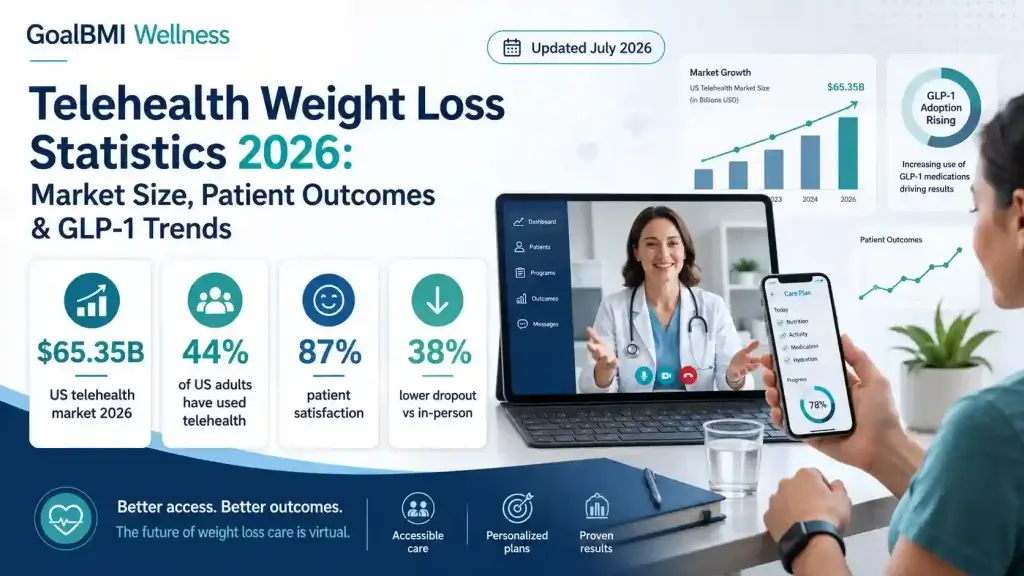
Telehealth has permanently changed how Americans access weight loss care. In 2026, the US telehealth market has grown to $65.35 billion — and telehealth-delivered weight loss programs combining physician supervision with GLP-1 medications are now considered the gold standard for accessible, evidence-based obesity treatment. This page compiles the most up-to-date statistics, clinical outcomes data, and market research available on telehealth weight loss in 2026.
Telehealth Market Size 2026 — United States & Global
The telehealth industry has sustained remarkable growth since the pandemic-era adoption surge, settling into a period of consistent double-digit annual expansion. In 2026, the US telehealth market alone is projected at $65.35 billion — more than double its pre-pandemic size.
North America Dominates the Global Telehealth Market
North America held 45.29% of the global telehealth market in 2025, contributing $84.43 billion. The region is projected to reach $98 billion in 2026. The US alone accounts for $65.35 billion of this, reflecting both a highly developed digital infrastructure and the post-pandemic normalization of virtual care. (Source: Fortune Business Insights, 2026)
US Market to Reach $317 Billion by 2034
The US telehealth market is projected to grow at a CAGR of 21.9% between 2024 and 2034, reaching $317.2 billion by 2034. Key drivers include the integration of GLP-1 programs into telehealth platforms, expanded Medicare and Medicaid coverage, AI-assisted care, and the permanent behavioral shift among patients toward preferring virtual care. (Source: Market.us, June 2026)
Telehealth Utilization Statistics 2026
Claims data from FAIR Health — one of the largest private insurance claims databases in the US — provides the most accurate real-world picture of telehealth utilization in 2026.
Who is Using Telehealth in 2026?
18.4% of Insured Patients Had at Least One Telehealth Claim in Q1 2026
FAIR Health’s Q1 2026 data shows that 18.4% of patients with insurance coverage received at least one telehealth service — up from 17.3% in Q4 2025. This represents the highest sustained utilization rate in the post-pandemic period.
Urban vs Rural Telehealth Gap Narrowing
Urban patients with at least one telehealth claim: 18.6%. Rural patients: 10.3%. However, rural telehealth growth was 7.8% quarter-over-quarter — outpacing urban growth of 6.2% — suggesting the access gap is slowly closing. (Source: FAIR Health, June 2026)
The Northeast Led Regional Telehealth Growth at +11.8% in Q1 2026
Regional variation in Q1 2026 telehealth utilization growth: the Midwest led at +12%, followed by the Northeast at +11.8%, the South at +9%, and the West at +8.1%. The strong Northeast growth directly reflects the patient population GoalBMI Wellness serves across New York, New Jersey, Pennsylvania, and Connecticut. (Source: FAIR Health, June 2026)
Mental Health Dominates — Weight Loss Growing Fast
Medicare Telehealth Statistics 2025–2026
Medicare telehealth coverage — which expanded dramatically during COVID-19 — has stabilized at significantly elevated levels compared to pre-pandemic rates, with ongoing policy debates about permanent extensions.
Medicare Telehealth Policy Extensions — Critical for Weight Loss Patients
Congress has extended Medicare telehealth flexibilities multiple times since the pandemic, with the most recent extension running through the end of 2026. These extensions allow Medicare patients to receive telehealth weight management services — including GLP-1 consultations — from their home. A permanent policy decision is expected in late 2026 and will significantly impact telehealth weight loss access for patients 65 and over.
Telehealth Weight Loss Outcomes vs In-Person Care
One of the most important questions for patients and providers is whether telehealth produces results equal to in-person weight management. The evidence in 2026 is clear: telehealth weight loss programs are clinically equivalent to in-person care — and in some metrics, outperform it.
Attendance Rates
Patient Satisfaction
Telehealth participants’ satisfaction regarding the benefits of the obesity management program in losing weight was 87% compared to 76% for the in-person group — an 11 percentage point advantage for virtual care. Patients cited the elimination of travel burden, flexible scheduling, and ongoing digital support as the primary reasons for higher satisfaction.
Dropout Rates
Telehealth Patients Are 38% Less Likely to Drop Out
Participant dropout rates were 13% for telehealth programs versus 21% for in-person programs. Reduced dropout is critical for weight loss outcomes — consistency throughout a program is the single strongest predictor of sustained results. The accessibility of telehealth removes the logistical barriers that cause many in-person patients to disengage. (Source: MDPI Healthcare Study, 2024)
| Metric | Telehealth Program | In-Person Program | Winner |
|---|---|---|---|
| Patient satisfaction | 87% | 76% | Telehealth ✓ |
| Session attendance rate | 97% | 75% | Telehealth ✓ |
| Program dropout rate | 13% | 21% | Telehealth ✓ |
| Weight loss outcomes | Equivalent | Equivalent | Equal |
| Blood pressure outcomes | Equivalent | Equivalent | Equal |
| Biochemical markers | Equivalent | Equivalent | Equal |
| Travel required | None | Yes — every visit | Telehealth ✓ |
| Geographic reach | Statewide | Local area only | Telehealth ✓ |
PubMed Meta-Analysis: Telehealth Weight Loss Comparable to In-Person Therapy
A systematic review published in PMC found that guided telehealth programs for treating obesity provided weight loss results equivalent to in-person therapy. Additionally, loss to follow-up trended lower among patients receiving telehealth care — meaning patients stayed more engaged, not less. (Source: PMC / National Library of Medicine, 2024)
GLP-1 Medications & Telehealth — A Natural Partnership
The explosion in GLP-1 prescribing for weight loss and the growth of telehealth have developed in parallel — and the combination has created the most accessible, effective weight loss delivery model in medical history.
Obesity is Ideal for Telehealth Management
Obesity is a chronic condition that benefits from frequent monitoring and physician counseling — but treatment and clinical decision-making rarely require physical examination. Key indicators like weight, BMI, and metabolic markers can all be monitored via telehealth with equal accuracy to in-person visits. This makes obesity one of the most naturally suited conditions for telehealth care. (Source: PMC / National Library of Medicine, 2024)
Telehealth Doubles the Reach of GLP-1 Programs
Before telehealth, GLP-1 programs required patients to travel to a bariatric clinic or specialist — often limited to major urban centers. Telehealth removes this barrier entirely, extending physician-supervised GLP-1 access to patients across entire states. For GoalBMI Wellness, this means serving eligible patients across New York, New Jersey, Pennsylvania, and Connecticut from a single platform.
Progress Bars — Key Performance Indicators
Real Patient Results from GoalBMI Wellness Telehealth Programs
These outcomes reflect physician-supervised telehealth patients who completed GLP-1 programs including tirzepatide (Zepbound®, Mounjaro®) and semaglutide (Wegovy®, Ozempic®) through GoalBMI Wellness. Results are consistent with what the clinical literature reports for supervised GLP-1 telehealth programs.

Results disclaimer: Individual results vary. Photos represent real patients from physician-supervised GoalBMI Wellness programs shared with patient consent. Results depend on individual health factors, program adherence, and medical evaluation. GLP-1 medications are prescription-only and require provider evaluation.
GoalBMI Wellness Program Pricing — Telehealth Weight Loss
One of the most common questions patients ask is what a telehealth GLP-1 weight loss program costs. GoalBMI Wellness offers transparent, straightforward pricing with self-pay options available for patients when insurance does not cover treatment — and insurance verification assistance for those who may qualify for coverage.

Context: TrumpRx Pricing Agreement — November 2025
In November 2025, the Trump administration announced a negotiated price agreement with Eli Lilly and Novo Nordisk, capping brand-name Mounjaro, Zepbound, Ozempic, and Wegovy at $245 per month through the TrumpRx program. GoalBMI Wellness works with licensed 503A compounding pharmacies to provide cost-effective access for eligible patients when clinically appropriate. See our full program pricing page for current options.
Telehealth & Weight Loss — Key Milestones Timeline
Frequently Asked Questions
Sources & Medical References
- 1FAIR Health (June 15, 2026). Quarterly Telehealth Regional Tracker — Q1 2026. fairhealth.org
- 2Towards Healthcare (March 2026). US Telehealth Market Size, Share, Growth — CAGR of 23.84%. towardshealthcare.com
- 3Fortune Business Insights (2026). Telehealth Market Size, Share, Growth. fortunebusinessinsights.com
- 4Market.us (June 2026). US Telehealth Market Size projected to reach $317.2 billion by 2034. market.us
- 5CompaniesHistory.com (2026). Telehealth Market Statistics 2026: Remote Care Adoption And Healthcare Usage. companieshistory.com
- 6Axis Intelligence (June 2026). Telehealth Statistics 2026: Market Size, Utilization, Mental Health Dominance. axis-intelligence.com
- 7CMS (2025). Medicare Telehealth Trends Dataset — January 2020 through September 2025. data.cms.gov
- 8MDPI Healthcare (2024). The Efficacy of Telehealth Versus In-Person Management Delivery in Adult Patients with Obesity. King Saud University. doi.org/10.3390/healthcare12212190
- 9PMC / National Library of Medicine (2022). Weight Loss Outcomes With Telemedicine During COVID-19. pmc.ncbi.nlm.nih.gov
- 10PMC / National Library of Medicine (2024). Adoption of telemedicine for obesity treatment during COVID-19 achieved comparable outcomes to in-person visits. pmc.ncbi.nlm.nih.gov
- 11OlaDigital Health (June 2026). Future of Weight Loss Clinics in 2026: GLP-1 & Telehealth. oladigital.health


-
Monday – Friday:: 9:00 AM – 8:00 PMSaturday:: 9:00 AM – 4:00 PMSunday:: 12:00 PM – 8:00 PM