
Sleep Apnea Statistics 2026 | Prevalence, Costs & Zepbound® OSA Data
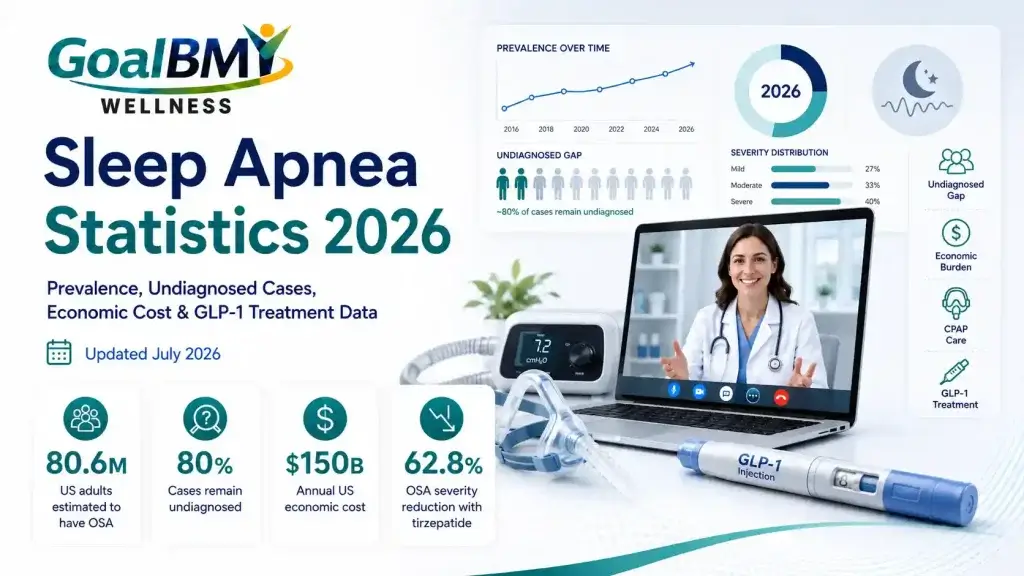
Sleep Apnea Statistics 2026: Prevalence, Undiagnosed Cases, Economic Cost & GLP-1 Treatment Data
The most comprehensive obstructive sleep apnea statistics resource for 2026. Covers US prevalence estimates, the 80% undiagnosed gap, $150 billion economic burden, the obesity connection, SURMOUNT-OSA trial results, and how Zepbound became the first medication ever approved for OSA.
Obstructive sleep apnea is one of the most common chronic conditions in America — and one of the least recognised. An estimated 80 million US adults have it, roughly four in five do not know, and untreated cases cost the economy around $150 billion every year. December 2024 marked a genuine turning point: for the first time in medical history, the FDA approved a medication to treat it. This page compiles what the current data actually shows.
How Many Americans Actually Have Sleep Apnea — And How Many Know It
Estimates vary depending on the diagnostic criteria used, but every recent analysis points in the same direction: obstructive sleep apnea is far more widespread than most people, and many clinicians, assume.
Most Cases Are Mild — But Moderate-to-Severe Still Means Millions
Severity distribution across US OSA cases is approximately 61% mild, 24% moderate, and 15% severe by one 2025 estimate, or 52% mild, 30% moderate, 18% severe by another. Even at the conservative end, that places roughly 31 million Americans in the moderate-to-severe range — the population for whom treatment is most clearly indicated and for whom Zepbound® is now FDA-approved. (Source: SLEEP, Oxford Academic, 2025)
94% of People With OSA Snore — But Snoring Alone Proves Nothing
While 94% of people with obstructive sleep apnea snore, the reverse is not true — most people who snore do not have OSA. Snoring is a signal worth investigating, not a diagnosis. Confirming OSA requires a sleep study, either in a lab or through an approved home sleep apnea test ordered by a physician.
The 80% Problem — Why Most Cases Never Reach a Diagnosis
The single most striking statistic in sleep medicine is not prevalence — it is how few people with the condition are ever identified. And the gaps continue even after diagnosis.
Undiagnosed OSA Has Consequences Beyond the Bedroom
Untreated sleep apnea is associated with hypertension, type 2 diabetes, depression, and stroke — and with significant public safety costs. The National Safety Council attributed 810,000 motor vehicle collisions and 1,400 fatalities in the United States to sleep apnea in a single year. Untreated OSA patients incur healthcare costs averaging $19,566 per year, driven primarily by inpatient care. (Source: Sleep Science / NIH PMC)
$150 Billion a Year — Counting the Cost of Leaving It Untreated
The American Academy of Sleep Medicine commissioned Frost & Sullivan to quantify what undiagnosed sleep apnea costs the United States annually. The breakdown reveals how much of the burden sits outside the healthcare system entirely.
| Cost Category | Annual Amount | Share of Total |
|---|---|---|
| Lost workplace productivity | $86.9 billion | 58% |
| Increased healthcare utilization | $30.0 billion | 20% |
| Motor vehicle crashes | $26.2 billion | 17% |
| Workplace injuries | $6.5 billion | 4% |
| Total annual burden | ~$150 billion | 100% |
Treatment Produces Measurable Return
In an AASM survey of 506 patients currently being treated for OSA, respondents reported a 40% decline in workplace absences after starting treatment, alongside better sleep and greater productivity. Approximately 78% of patients said sleep apnea treatment was a good investment. (Source: AASM / Frost & Sullivan)
What the BMI Data Reveals About Weight and Airway Collapse
Obesity is the single most modifiable risk factor for obstructive sleep apnea. But the relationship is more nuanced than “obesity causes sleep apnea” — and understanding that nuance matters clinically.
60% of Moderate-to-Severe Cases Are Attributable to Obesity
While most OSA cases overall are not in people with obesity, the picture changes at higher severity. Approximately 60% of moderate-to-severe OSA cases are attributable to obesity, and an estimated 41–70% of US patients with OSA have obesity. This is precisely why weight-based treatment has the strongest evidence in the moderate-to-severe population — and why the FDA approval for Zepbound® was specifically limited to adults with obesity. (Source: ResMed clinical FAQ, 2026)
December 2024 — The Month Sleep Apnea Treatment Changed
On December 20, 2024, the FDA approved Zepbound® (tirzepatide) for moderate-to-severe obstructive sleep apnea in adults with obesity. It was the first pharmaceutical treatment ever approved for the condition — after decades in which the only options were mechanical or surgical.
SURMOUNT-OSA — What the Trials Measured
The SURMOUNT-OSA program comprised two parallel phase 3 trials, both using change in the apnea-hypopnea index (AHI) from baseline as the primary endpoint. AHI counts breathing interruptions per hour of sleep.
| Trial Design Element | Detail |
|---|---|
| Trial 1 | n=234 — participants unable or unwilling to use PAP therapy |
| Trial 2 | Participants already receiving PAP therapy at baseline |
| Population | Moderate-to-severe OSA (AHI ≥15 events/hour) with obesity (BMI ≥30), without type 1 or type 2 diabetes |
| Dosing | Tirzepatide maximum tolerated dose (10mg or 15mg) vs placebo |
| Primary endpoint | Change in apnea-hypopnea index (AHI) from baseline |
| Headline result | Up to 62.8% reduction in AHI vs placebo — P<0.001 for superiority |
| Publication | Malhotra A, et al. NEJM 2024;391(13):1193–1205 |
Real-World Data Points the Same Direction
A retrospective claims analysis found that patients on anti-obesity medications had an OSA incidence of 3.12% versus 12.56% in the non-medicated cohort — a 40% lower likelihood of developing OSA after adjustment (hazard ratio 0.60, p<0.0001). Tirzepatide users showed slightly lower OSA incidence than semaglutide users (2.65% vs 3.18%), though the difference did not reach statistical significance after adjustment. (Source: Medical Research Archives, January 2025)
📖 Related Programs at GoalBMI Wellness
Where CPAP Still Wins — And Where Medication Fits Alongside It
The arrival of a drug treatment has not displaced positive airway pressure therapy. Understanding what each does — and does not do — matters for anyone weighing options.
GLP-1 Use Is Associated With Higher CPAP Initiation, Not Lower
A ResMed analysis of real-world IQVIA data found that patients with an OSA diagnosis who filled a GLP-1 prescription were 10.8 percentage points more likely to initiate CPAP therapy than those who did not. Rather than replacing PAP therapy, GLP-1 treatment appears to coincide with greater engagement in OSA care overall — likely reflecting patients who are actively addressing their health across multiple fronts.
What Patients Told Researchers About Their Preferences
The PRO-CON OSA survey, conducted from November 2024 to August 2025 across US patients and 114 sleep medicine providers, found that among patient respondents: 73% had attempted weight loss three or more times, 77% had used CPAP, and 21% had used GLP-1 receptor agonists such as tirzepatide. Most reported at least one comorbidity such as hypertension alongside frequent sleepiness, fatigue, or unrefreshing sleep. (Source: PRO-CON OSA Survey, UCSD, 2025)
Where the Numbers Stand — Key Sleep Apnea Metrics
Projecting Forward to 2050 — What the Modelling Studies Predict
A prospective modelling study published in The Lancet Respiratory Medicine in August 2025 projected the 30-year trajectory of obstructive sleep apnea in the United States, factoring in population age, sex, and BMI distribution changes.
More OSA Drug Trials Are Now Underway
Zepbound® is unlikely to remain the only option for long. The ATTAIN-OSA phase 3 trial is currently evaluating orforglipron — an oral GLP-1 — for moderate-to-severe obstructive sleep apnea in adults with obesity or overweight. Study design and baseline characteristics were published in Contemporary Clinical Trials Communications in 2026. The therapeutic landscape for OSA is likely to look materially different within a few years.
From CPAP to Pharmacotherapy — A Treatment Timeline
Accessing Physician-Supervised Tirzepatide for Obesity and OSA
GoalBMI Wellness provides physician-supervised tirzepatide programs via telehealth for eligible patients. If you have been diagnosed with moderate-to-severe obstructive sleep apnea and have obesity, Zepbound® may be clinically appropriate — a licensed provider will assess this during your evaluation.

Programs available via telehealth across New York, New Jersey, and Pennsylvania.
Before & After — Weight Reduction in Supervised Tirzepatide Programs
These results are from real GoalBMI Wellness patients in physician-supervised GLP-1 programs. In SURMOUNT-OSA, improvements in apnea-hypopnea index tracked alongside weight reduction — which is the mechanism by which tirzepatide affects sleep apnea severity.

See more patient before & after results →
Results disclaimer: Individual results may vary. Photos represent real patients from physician-supervised GoalBMI Wellness programs shared with patient consent. These images depict weight loss outcomes and are not a representation of sleep apnea treatment results. Results depend on individual health factors, program adherence, and clinical evaluation.
Questions Patients Ask About Sleep Apnea and GLP-1 Treatment
Explore the Full GoalBMI Statistics Library
📊 All 2026 Statistics Reports
Sources & Medical References
- 1Malhotra A., Grunstein R.R., Fietze I., et al. (2024). Tirzepatide for the Treatment of Obstructive Sleep Apnea and Obesity (SURMOUNT-OSA). NEJM 391(13), 1193–1205. nejm.org
- 2U.S. Food and Drug Administration (December 20, 2024). FDA approves first medication for obstructive sleep apnea. fda.gov
- 3SLEEP / Oxford Academic (2025). Unmasking Obstructive Sleep Apnea: Estimated Prevalence and Impact in the United States. 80.6M adults, 32.2% prevalence. academic.oup.com
- 4SLEEP / Oxford Academic (2025). Prevalence and Unmet Need of Obstructive Sleep Apnea in the United States. 80% undiagnosed, treatment funnel data. academic.oup.com
- 5American Academy of Sleep Medicine / Frost & Sullivan. Economic burden of undiagnosed sleep apnea in the U.S. is nearly $150B per year. aasm.org
- 6NIH PMC (2025). The relationship between obesity and obstructive sleep apnea in four community-based cohorts: IPD meta-analysis of 12,860 adults. ncbi.nlm.nih.gov
- 7Boers E., Barrett M., Benjafield V. (August 2025). Projecting the 30-year burden of obstructive sleep apnoea in the USA: a prospective modelling study. Lancet Respir Med. pubmed.ncbi.nlm.nih.gov
- 8Baser O., et al. (January 2025). Tirzepatide and Semaglutide for the Treatment of Obstructive Sleep Apnea and Obesity: A Retrospective Analysis. Medical Research Archives 13(1). esmed.org
- 9ResMed (2026). FAQ: Anti-Obesity Medications and Obstructive Sleep Apnea. Clinical guidance on GLP-1s alongside PAP therapy. resmed.com
- 10Faria A., et al. (2021). The public health burden of obstructive sleep apnea. Sleep Science. Motor vehicle collision and healthcare cost data. ncbi.nlm.nih.gov
- 11PRO-CON OSA Survey (2025). Treatment Preferences For Comorbid Obesity and Obstructive Sleep Apnea: Patient and Provider Preferences for CPAP and/or Tirzepatide. UCSD / medRxiv. medrxiv.org
- 12American Academy of Sleep Medicine (2026). Zepbound® (tirzepatide) for Obstructive Sleep Apnea — provider fact sheet. aasm.org
Medically Reviewed by Karla K. Mioduchoski, FNP-BC
Karla K. Mioduchoski, FNP-BC is a board-certified Family Nurse Practitioner providing physician-supervised medical weight loss, GLP-1 support, peptide therapy, and telehealth wellness care through GoalBMI Wellness. All statistical data in this article was reviewed for clinical accuracy in July 2026.


-
Monday – Friday:: 9:00 AM – 8:00 PMSaturday:: 9:00 AM – 4:00 PMSunday:: 12:00 PM – 8:00 PM