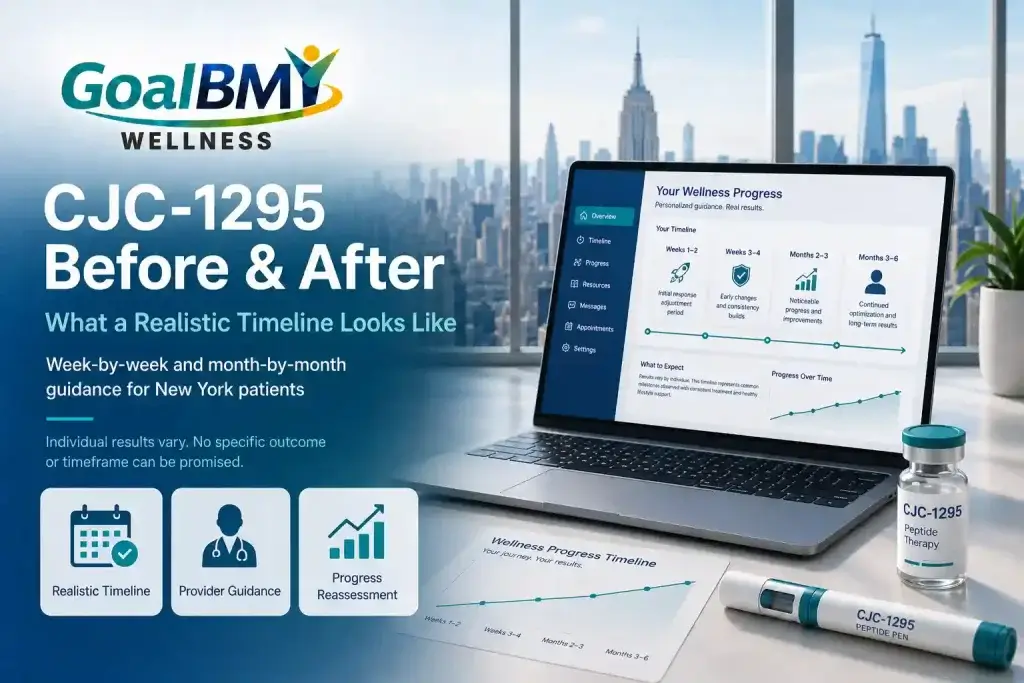
CJC-1295 Before & After Results: A Realistic Timeline
CJC-1295 Before & After: What a Realistic Timeline Looks Like | GoalBMI Wellness
CJC-1295 Peptide Therapy · New York
What Changes When — And Why Every Patient’s Timeline Differs
A grounded, week-by-week and month-by-month look at when patients typically notice changes with CJC-1295 — and the factors that shape individual results.
Written by Karla K. Mioduchoski, FNP-BC|Medically Reviewed by Dr. Rosemary Daly, D.O.|Updated for New York patients
One of the most common questions patients ask isn’t what CJC-1295 does — it’s when they might notice something. This page walks through a realistic timeline based on how the peptide is understood to work, while being upfront that individual response varies significantly and outcomes are never guaranteed.
Quick Answer: Some patients report noticing subtle changes — like sleep quality or recovery — within the first few weeks, while more noticeable changes in body composition or energy are typically discussed over a three-to-six month window. Timelines vary significantly by individual, and no specific outcome or timeframe can be promised.
Setting Expectations
Why timelines vary so much between patients
CJC-1295 is studied for its effect on the body’s natural growth hormone signaling — a gradual, physiological process rather than an immediate one. Because of this, and because CJC-1295 is not FDA-approved for general clinical use with standardized outcome data, timelines discussed here are general patterns rather than promises.
No two patients are the same. Age, baseline hormone levels, consistency with the treatment plan, sleep, nutrition, and overall health all influence how — and whether — someone notices changes. Your provider can help set realistic, individualized expectations.
Week by Week
A general week-by-week outline
Weeks 1–2
Starting Out
Most patients are still adjusting to injection routine and reconstitution during this window. Any early changes reported by patients tend to be subtle, such as sleep quality — and are not consistent or guaranteed.
Weeks 3–4
Early Adjustment
Some patients describe noticing changes in recovery after exercise or a subtle shift in energy. This is anecdotal and highly individual — not every patient reports this, and it should not be expected on a fixed schedule.
Weeks 5–8
Building Consistency
By this point, most patients have an established routine. Provider follow-up typically checks in on tolerance, injection technique, and any early observations, adjusting the plan as needed.
Month by Month
A general month-by-month outline
Month 1
Establishing the Routine
Focus is on tolerance, technique, and consistency. This is typically not the phase where noticeable changes in body composition are expected.
Months 2–3
Early Patterns May Emerge
Some patients report noticing changes related to recovery, sleep quality, or general sense of wellbeing during this window. This varies significantly and is not a guaranteed outcome for every patient.
Months 3–6
More Noticeable Changes Discussed
If changes in body composition or energy are going to become more apparent, this is generally the window where patients and providers discuss reassessing progress together.
6+ Months
Ongoing Reassessment
Continued use, if appropriate, is reassessed periodically with your provider based on how you’re responding, your goals, and any changes in your health status.
“Patients sometimes come in expecting a fixed timeline, like a prescription for a specific result by a specific week. That’s not how peptide therapy works, and being upfront about that from day one leads to better, more honest conversations.”
— Karla K. Mioduchoski, FNP-BC
What Actually Matters
Factors that affect individual results
Biology
Age & baseline levels
Starting hormone levels and age-related factors influence how someone may respond to GHRH-analog therapy.
Consistency
Adherence to the plan
Following the prescribed schedule as directed matters more than any other single factor within a patient’s control.
Lifestyle
Sleep, nutrition & activity
Growth hormone signaling interacts closely with sleep and overall lifestyle — these aren’t separate from treatment, they’re part of it.
Guidance, Not Guarantees
Before-and-after guidance: what to keep in mind
Ask your provider what a realistic, individualized timeline looks like for your specific situation
Track how you feel honestly rather than comparing yourself to anecdotes online
Bring questions and observations to every scheduled follow-up
Understand that stopping therapy generally means stopping any changes associated with it
No outcome is guaranteed. Any before-and-after description you may see — including patient anecdotes — reflects individual experience and is not a predictor of your own results. CJC-1295 is not FDA-approved for general clinical use, and treatment should always be guided by a licensed provider.
Answers
Frequently asked questions about the CJC-1295 timeline
There’s no fixed timeline. Some patients report subtle changes within the first few weeks, such as sleep quality, while more noticeable changes — if they occur — are typically discussed over a three-to-six month window. Individual response varies significantly, and no specific outcome can be promised.
Bring this up with your provider at your next follow-up. They can review your plan, discuss whether adjustments are appropriate, and help set realistic expectations based on your individual situation. Not every patient experiences the same response.
Any changes associated with therapy are generally understood to relate to continued use. Discuss with your provider what to expect if you’re considering stopping, since this is highly individual and not well established in long-term data.
Yes. Age, baseline hormone levels, consistency, sleep, and overall health all affect individual response. Comparing your timeline to someone else’s experience isn’t a reliable way to judge your own progress — your provider is a better resource for that conversation.
Every patient’s situation is different. A licensed New York provider can walk you through what a realistic, individualized plan and timeline may look like for you.
Curious how this looks for Florida patients?Florida Surgery & Weight Loss Center
— part of the same practice as Karla K. Mioduchoski, FNP-BC — discusses realistic CJC-1295 timelines
for patients across the state.
⚠️ Medical & Educational Disclaimer: This page is for educational purposes only and does not constitute medical advice. CJC-1295 is a peptide that has not been approved by the FDA for general clinical use; it is prescribed only where clinically appropriate following evaluation by a licensed provider. Nothing here should be taken as a promise of specific results, and no dosing information should be used to self-treat. Always follow the exact instructions of your prescribing provider. Peptide therapy is available only to eligible patients in states where our providers are licensed. In a medical emergency, call 911.
Get Started
Book an appointment and take the first step toward better health.